Edit: the change in population argument makes sense. I’ve always thought it was flawed as a good friend of mine is short, very stocky, and fit - but is technically “obese”.
It's accurate when measuring populations, where the missing variables average out. It isn't meant to be applied to individuals but is good enough for expedient's sake.
That is untrue. There's no research to support the idea that BMI is a particularly useful tool (compared to, say, neck vs waist circumference) or that the thresholds it sets are meaningful (e.g., that an increase from 24.7 to 24.9 is a lesser or greater increase of risk than an increase from 24.8 to 25.0).
Measured overtime for a population - it seems to be very good given how easy it is to measure.
I'd love it if there was technology at some point accessible to everyone that would allow for more informative measurements (w/ privacy considerations).
This comment makes it sound like while Americans don't belong to gyms, tons of them are into fitness. This is absolutely not the case and seems rather disingenuous to suggest.
It is for individuals but it's reasonable to use as a population measure. Waist-to-height and waist-to-hip ratios are also good measures for population-level health and those work a little better for individuals.
It's especially reasonable when we're talking about changes in BMI instead of levels regarding a population. That can only be driven by the population getting fatter.
Admittedly accurate is the wrong term, but it is a reasonable inductor of health, as the heavier someone is for a given weight, the shorter their expected lifespan will be.
The normal weight may change, but the ideal healthy weight doesn't. The idea of a healthy weight is misleading, as there is more of a healthy body fat percentage. Even that's is an oversimplification, as visceral fat has far more health implications that subcutaneous fat.
Most Americans used to be farm workers. It's only in the past thirty years that most Americans stopped living/working in rural/agrarian settings and began living in cities.
We have more sedentary work, so that's a factor.
I also wonder a lot about other things that have changed and how that impacts our bodies, including weight. There are a lot of things that have changed which don't get questioned in terms of "How does that impact health?" and which I hesitate to specify because I'm pretty sure it will get dismissed as crazy talk to wonder about the connection between such things.
>Most Americans used to be farm workers. It's only in the past thirty years that most Americans stopped living/working in rural/agrarian settings and began living in cities.
What? Is there a typo here? 30 years ago was 1991. Are you saying that most Americans were living in agrarian settings in 1991?
Sorry for the sloppiness. I think the thrust of my point is accurate: We used to have more physical jobs and the world on the whole became citified relatively recently. But I'm probably running a fever and mashed a few things together in my brain inaccurately.
Fair enough. The US was obviously much further ahead than the global numbers and which throws off the timing of any potential link between a transfer away from an agrarian society. Americans by and large stopped farming decades before we all became obese.
My ex husband was career military. At some point while he was in the military, they changed the fitness requirement for younger members but not for him and this really pissed him off. They told him "You have been working out your whole life. You are in the best shape of your life." but after a workout or PT test, he was really winded and needed substantial recovery time that the young guys did not need. They were fine within minutes.
The change was really rooted in the fact that younger people coming in were less fit. Young people used to take summer construction jobs and from what I gather that no longer happens anywhere near as much as it used to, which leaves the construction industry struggling to fill those jobs.
Kids used to run and play outside and now they play video games at the TV or the computer and hardly leave the house compared to when I was growing up. And there are just a whole lot of factors there.
My father grew up on a farm, though my father was born in the 1920s. I grew up with a garden out back and we used to go on public lands and pick blue berries in summer and part of the meat on our table was squirrel and deer meat that my father hunted (or, one year, a friend of his gifted us half a buck to fill our freezer).
I grew up in the 'burbs. I am sure there are still people who hunt and gather as part of their way of life, but I mostly hear this about Native Americans, especially in Alaska which is relatively undeveloped. There seems to be a lot less of that sort of thing for people in cities or suburbs, but I have no actual data on that. That's just an impression and I don't know how much that impression is skewed by personal experience, which doesn't always align with aggregate statistics.
But I'm quite clear we generally have less physical jobs/lives overall and more citified lives overall than when I was growing up.
I'm sure that's a big factor, but I also think there are myriad other factors that get short shrift and we mostly don't bother to discuss them. As just one example: Urban planners used to take fitness into consideration when planning cities and my understanding is this is mostly a thing of the past.
I am not dismissing anything you are saying as they are all clearly part of the problem. I simply think the timelines for these big societal changes don't match the numbers from the obesity epidemic for them to be the primary factors.
No, sorry, I don't think you are dismissing anything. I think you've been really kind about the whole thing, characterizing it as "is that a typo?"
I'm just talking. There's a global pandemic and like most of the world right now, I don't get out much.
I'm trying to do other things and leave this conversation. I don't think I really have more to add. I'm not upset with you and I'm not feeling defensive. I'm just rambling.
The type of food we eat has a major impact on the prevalence of overweight individuals. The fast/easy food is the most calorie dense, most affordable, and least satiating compared to the food we used to eat 40+ years ago. Even adjusting for eating habits and lifestyle differences (sedentary people tend to get bored and snack) the food itself is just more efficient at delivering calories than it used to be and our population hasn't adjusted to this fact.
Given how desperately most people want to be thin and beautiful, if our standard answer of "calories in and calories burned" as our sum total understanding of how weight gain works were accurate, I imagine we wouldn't be seeing stats like "nearly three fourths of Americans are overweight."
One reason this strikes me as implausible is that I doubt other similarly urbanized societies (e.g. Japan) have overweight and obesity rates anywhere near ours.
Most urbanized societies don't have quite the suburb plague that the US has. It's much easier to get physical activity just by existing (walking to/from bus and train stations or to the office in many cases).
We need to consider that endocrine disruptors (the plastics mentioned) may interfere with the systems that control feeding behavior such as leptin and ghrelin.
But when you completely upend society in a generation, changing a thousand variables at once, I do not personally feel comfortable saying "far more likely" about any particular cause for any particular societal outcome.
-Increasing use of social media and sedentary lifestyles. When you are just inside on your phone all the time this is NOT healthy.
-This obesity problem is probably going to kill more people than COVID and the opioid epidemic, but noone wants to talk about it as it directly threatens various established interests.
> but noone wants to talk about it as it directly threatens various established interests.
There are many people talking about it. Adhering to healthy life style is difficult for many people. Most obese know perfectly well why they are obese an what it takes to be healthy.
Fwiw I've been doing 100% Huel Black and a keto dinner for the last two months, and never felt better. It takes the decision fatigue of "does this fit in my diet" out of it all, and makes eating right so much easier. I honestly feel like my brain is functioning better now too, just one less thing gnawing away at it. And I like Huel Black because it's kind of gross, so no urge to overconsume, which I've run into with other products. Plus, it feels somewhat nice in that it's probably one of the more environmentally friendly ways to eat.
I never would have thought I'd be able to keep up with it (love sugar too much) but actually it's been not so hard once I set my mind to it. I gave up alcohol a few years ago and this has been easier than that.
We'll see how long it lasts. It seems weird to think about doing it forever, but who knows. For now I see no reason to stop, and lots of reasons to keep going.
flavor fatigue often eventually kicks in with meal replacements, but buying a variety of brands, flavors, and even now some of the savory alternatives helps with that.
but yes if school lunches had a meal shake option many kids would prefer its flavor over the existing options. and its miles healthier.
I'm not anti-tax, but a better way would be to stop subsidizing sugar production so much. Less subsidies would drive up prices, making a tax redundant.
However, since that's only federally, it's less attractive. States would probably prefer a tax on a per-state basis, since it would be a source of revenue for them, unlike the savings from federal subsidy cuts.
Knowing me I'd still buy it no matter the cost and just end up poorer.
I'd prefer unlabelled products and no advertising etc to a tax. I dunno. It seems healthy living and the current food industry are perhaps fundamentally incompatible. I would support some form of regulation aimed at improving public health outcomes, but struggle to see a tax as the answer for me personally, though it may work for some.
Giving poor people food stamps largely increase share of sugar bought from super markets compared to those who don't get it but are otherwise equally poor, so currently USA subsidizes unhealthy food habits via tax dollars.
Japanese "metabo law" [1] financially pressures citizens to adapt to physical standards established by the state as a precautionary measure to prevent future medical labor demand absorbed by the gluttonous, idle citizen.
It blows me away that John Mackey, the founder of Whole Foods, frequently says that people need to eat healthier, and the twitterverse absolutely excoriates him. It's seriously disturbing. COVID is of course helping expose that we have run out of "real" problems and unlike any other time in history, people now have the option available to literally become fat, dumb, and lazy. I realize it's a touchy subject, but I think it's a mistake to not stigmatize obesity (not overweight but obese) the way we do smoking. Incentives matter...this might sound cruel, but have insurance stop covering health problems related to obesity and watch how quickly people stop eating McDonald's four times a week. Clearly I prefer a tough love approach on this issue.
>I realize it's a touchy subject, but I think it's a mistake to not stigmatize obesity
Where do we stop then? Depression can often be avoided or cured by changing to a more healthy lifestyle. Should those with depression and a not-so-healthy lifestyle also be stigmatized and have no health insurance?
Depression should not be stigmatized, but neither should we turn a blind eye. Those suffering from depression and obesity should have access to the resources they need to tackle those issues, and should be encouraged to seek them out.
And no one should be denied health insurance for any reason, obviously. (Unless you're proposing abolishing private health insurance completely, in which case yes please.)
>unlike any other time in history, people now have the option available to literally become fat, dumb, and lazy
It's incredible when you put it that way. Stated another way, at least in some parts of the world, our quality of life has gotten so high that we can now afford to lower it on purpose.
I was about to say in my post, "Our standard of living has become so high..."
We have so many resources that for the first time in human history, this is actually a viable option for people. It's wild to think about. I wish you could travel back in time and explain this to someone a century ago, their brains could short circuit.
The reaction to a message often depends on the messenger.
My understanding is that Whole Foods is a premium supermarket, so perhaps some people feel he is being a bit out of touch with a large portion of the population. A bit like the famous "let them eat cake" suggestion...
>I realize it's a touchy subject, but I think it's a mistake to not stigmatize obesity (not overweight but obese) the way we do smoking
I won't get a heart attack from your second hand obesity. There are a lot of other unsafe behaviors that have more severe negative externalities than obesity.
Obesity isn't contagious and doesn't pose a direct threat to anyone but the obese person. This isn't true of numerous other harmful behaviors that have greater negative externalities. If you want to work to stigmatize bad parenting, be my guest. Obesity of a parent isn't a symptom of bad parenting.
What happens when you're in some sort of accident, need treatment, but that treatment is slowed because obese people are clogging the health care system?
This is a bizarre hypothetical. Do you have any examples of someone in an acute medical emergency not receiving treatment because "obese people are clogging the health care system"?
Also what about all the other people who are "clogging the health care system"? Does the drinker with liver problems? What about the cyclist who needs to have surgery to repair a compound fracture they got in an accident? How about the surfer who has skin cancer from being in the sun too much? What about all the old people in the health care system? Do you deserve medical attention over them?
If the problem is not having capacity for medical system, let's build more capacity not stigmatize the people who need medical care.
Is 73% of the population surfers? Or are 73% of Americans alcoholics? This is a very large percentage of the population that will increasingly encounter health issues within a healthcare system with an artificially capped number of physicians.
Good food is expensive and many Americans can’t afford it. Part of the reality is that fresh food is not easily available, expensive and requires a modicum of skill to prepare into a meal.
More Americans are dependent on processed food than ever. Except that processed food has declined in quality and nutritional value over the past few decades, primarily to keep costs under control. There are confounding factors but this is a key driver.
As the world’s reserve currency, the USD does not experience inflation in the same manner as most other countries. Rather than food prices skyrocketing, quality and optionally portions are reduced to compensate for declining purchasing power.
"Good food is expensive" is a baseless claim I hear all the time. People could eat relatively healthy if they wanted to, but they don't. There are a bunch of reasons, but if I was forced to pick one it's that these big companies engineer their processed food to be addictive. It's insidious.
> People could eat relatively healthy if they wanted to, but they don't. [emphasis added]
It's not an issue of want. I've lived in a near food desert. I was in a relatively well-off part of a very poor part of town (many people lived without cars, high unemployment, etc.). The local grocer had god awful meat and produce (produce would spoil in 1-2 days of purchase, meat wasn't much better). To get good food I'd drive sometimes 10+ miles away and get, for the same list price, much better quality meat and vegetables. I wasn't breaking the bank, but I had access to a vehicle and the time to take to go make the purchase (the local grocer was only good, for me, for staples like dried beans, rice, and flour). The others living nearby without a car, or without the time/money to dedicate to that extra trip for groceries had to subsist on what was available locally, which meant often some very poor quality foods (with regard to health outcomes at least).
Otherwise, I agree that good food is not expensive. I saved money and got healthier by spending less on food (chicken breast and ground beef at $2-3/pound, catch on sale days and freeze; rice and beans cost maybe $10/month as a single adult; a few key vegetables and fruits cost $5-10/week).
If there was demand for good food people would open shops selling it. It happens all the time in Europe, you see poor people open cheap shops selling basic food in poor areas.
The key difference is population density. There is a demand, but its too low to be sustainable.
And by the way, you have food deserts in europe (Alps, Balkans). I've never been to Estern Europe but a friend of mine is selling mercs (security detail to be exact) there and i souldn't be surprise if some food desert existed between Crimea and Oural from what i'm told.
Small productor market and product are politically tainted too, so a small percentage of the population won't ever come in. And health shouldn't be about politics.
> If there was demand for good food people would open shops selling it.
Markets aren't perfect, contrary to popular belief on HN and other discussion boards. And even if something eventually shows up, it's not going to show up overnight. It still takes capital to pull off, which the locals almost universally lacked (racism is a hell of a thing in the US South) and outsiders have to decide it's worth the gamble for very little gain. How many people want to open a grocery store where 90% of your customers are on food stamps, and if they open it how well stocked will it be? (Based on the one grocery store we had, very poorly.)
I sympathize, seriously. "Food deserts" are real, but they're not a conspiracy...it's just capitalism. They're not economically viable in areas where too many people reject "good food" in favor of Big Macs. Food deserts are a symptom of my point: people are choosing (or are addicted to) processed food.
The causation you're indicating is not clear at all to me. You seem to be saying, "Poor people prefer Big Macs therefore that's what they get, and no grocery stores."
But an equally valid observation is that the lack of grocery stores and the presence of fast food and gas stations/corner stores produce an apparent preference without indicating a real preference.
Food deserts doesn't exist in most countries though, it is an American thing. Nowhere else is it hard to go find basic groceries you can use to cook anywhere.
I don't get your point with this comment. bedhead suggested that Big Mac consumption by poor people leads directly to their food desert problem, my comment is that that causal order is not clear. An apparent preference can be created by lack of choice, not by actual choice.
Do people in food deserts prefer Slim Jims from the corner store and Big Macs or does it seem that way because of a lack of choice?
Do you have a good source for good food is expensive? I've heard this before, but it seems like plenty of "good" food is inexpensive like rice, beans, lentils, eggs, root veges, yogurt, oats and spinach.
There are other contributing factors as well, intrinsically linked to the evolving social/economics dynamics in our society. For example, it's now much more common for families to have two working parents, and thus less time to prepare nutritionally complete food from scratch. So people naturally gravitate toward engineered food which is easier to prepare, but less "good" as food. There are many other similar effects that lead to Americans eating more/poorer food like advertising, school lunches, etc, but the deck is definitely stacked against this world to reverse the obesity epidemic.
That's not really true. Most diets are bad because of the crap they include, not because of expensive for that a person cannot afford. Most people's diets can be improved by simply removing sugar and alcohol!
It is not simply that the USD is the reserve currency; the US has also changed how it measures CPI (to the benefit of the government and detriment of those on social security). This investopedia article is a pretty good summary
What's the data around "many"?
How much of this is about accessibility?
How much of this is about education?
How much is making affordable going to solve the problem enough?
I ask sincerely - but in transparency it does come from a sense that its not as much to do w/ cost as it seems to be from my perspective.
I'm aware there is research on what are referred to as "food deserts" where people who may not have reliable transportation are stuck with corner stores and fast food in their neighborhood. Unfortunately I can't point you toward any studies in particular but the research is out there.
One can be skinny on crappy food and obese on healthy. It is simply calories consumed vs calories spent bar few exceptions. And for increasingly more and more people stuffing themselves have become the only way to "get away from it all".
The big exception to that is when a diet it high in sugar, then you don't need quote so many extra calories to get fat; rather like the typical American sorry
It took me seconds to find credible information arguing against your assertion: "Using the model, we found that fatter individuals would indeed survive longer and, at a given body weight, females would survive longer than males, when totally starved"
A mathematical model of weight loss under total starvation: evidence against the thrifty-gene hypothesis
This isn't even arguing with what I said. I said at the point of starvation, being obese is only going to let you live for a few more days longer than a skinny person assuming you dont get any more food until death.
This paper is arguing that they are more likely to survive in general, which is obvious.
Alright, I'm gonna say it just so you're aware of why. I'm your third downvote as of this edit.
There is literally zero reason to invoke a flamebait topic such as incel culture in this thread. It contributes nothing of value and detracts from otherwise meaningful conversation.
My comment doesn't contribute anything of value either; I'm only saying it so you're not in the dark as to why you're being downvoted. More likely than not, it's because invoking political hot-button topics in a thread that has absolutely nothing to do with such is a recipe for disaster.


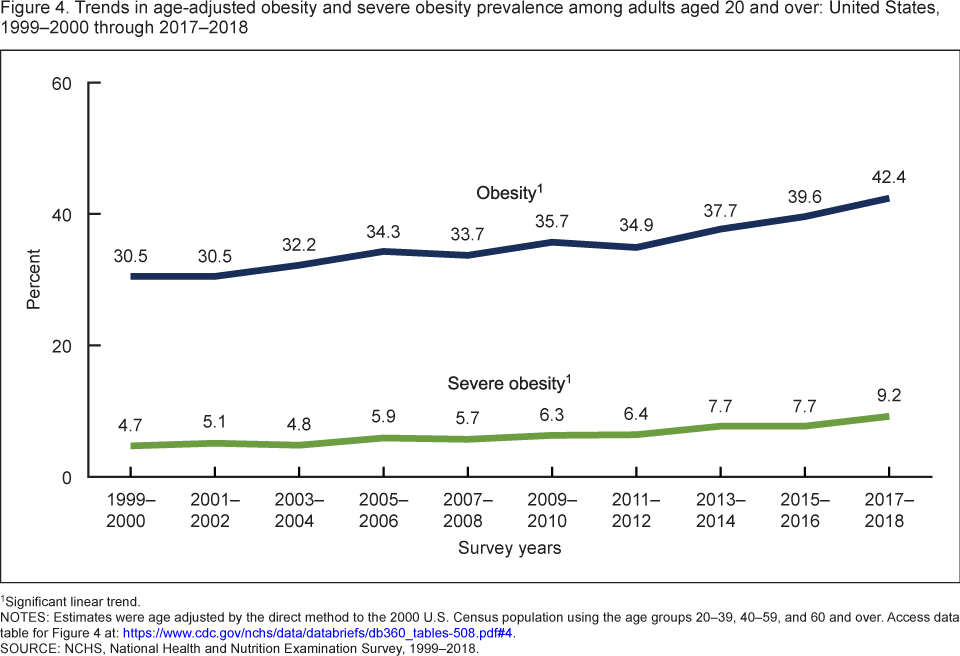
Edit: the change in population argument makes sense. I’ve always thought it was flawed as a good friend of mine is short, very stocky, and fit - but is technically “obese”.
Edit 2: I was curious how this trend looks going back further than the 80’s. “The evolution of BMI values of US adults: 1882-1986” https://voxeu.org/article/100-years-us-obesity