ollama has made a lot of nice contributions of their own. It's a good look to give a hat tip to the great work llama.cpp is also doing, but they're strictly speaking not required to do that in their advertising any more than llama.cpp is required to give credit to Google Brain, and I think that's because llama.cpp has pulled off tricks in the execution that Brain never could have accomplished, just as ollama has had great success focusing on things that wouldn't make sense for llama.cpp. Besides everyone who wants to know what's up can read the source code, research papers, etc. then make their own judgements about who's who. It's all in the open.
Newton only gave credits to "Gods". He said he stands on shoulders of Gods or something like that. But he never mentioned which Gods in particular, did he?
Fair. I didn't want to assume the worst, that it was just rhetorical slight of hand where "providing release packaging around an open source? you should credit it, at some point, somewhere." is implied as ridiculous, like asking llama.cpp to credit Google Brain. (Presumably, the implication is, for transformers / the Attention is All You Need paper)
If you're going to accuse me of rhetorical sleight of hand, you could start by at least spelling it correctly. This whole code stealing shtick is the kind of thing I'd expect from teenagers on 4chan not from someone who's been professionally trained like you. Many open source licenses like BSD-4 and X11 are actually written to prohibit people from "giving credit" in advertising in the manner you're expecting.
I'm 35, got my start in FOSS by working on Handbrake at 17 when ffmpeg was added.
There, I learned that you're supposed to credit projects you depend on, especially ones you depend on heavily.
I don't know why you keep finding ways to dismiss this simple fact. (really? spelling? on Saturday morning!?!? :D).
Especially with a strong record of open source contributions yourself.
Especially when your project is a classic example of A) building around llama.cpp and crediting it. I literally was thinking about llamafile when I wrote my original comment, before I realized who I was replying to.
I'm really trying to find a communication bridge here because I'm deeply curious, and I'd appreciate you doing the same if I'm lucky enough to get a reply from your august personage again. (seriously! no sarcasm!) My latest guesses:
- you saw this post far after the early tide of, ex., exaggerating for clarity, "anyone got the leak on the deets on how these wizards did this?!?!?! CUDA going down!"
- You're unaware Ollama _does not mention or credit llama.cpp at all_. Not once. Never. Google search query I used to verify my presumption is `site:ollama.com "llama.cpp"`. You will find that it is only mentioned in READMEs of repos of other peoples models, mentioning how they quantized.
- You're unaware this is an ongoing situation. Probably the 3rd thread I've seen in 3 months with decreasing #s of people treating it like a independent commercial startup making independent breakthroughs, and increasing #s of people being like "...why are you still doing this..."
For those unfamiliar, this is how jart's llamafile project credits llama.cpp, they certainly don't avoid it altogether, and they certainly don't seem to think its unnecessary. (source: https://github.com/Mozilla-Ocho/llamafile)
- 2nd sentence in README: "Our goal is to make open LLMs much more accessible to both developers and end users. We're doing that by combining ___llama.cpp___ with Cosmopolitan Libc into one framework"
- 21 mentions in README altogether.
- Under "How llamafile works", 3 mentions crediting llama.cpp in 5 steps.
Look, there's a very simple way we can prove or disprove if ollama is doing something wrong. The MIT license (which llama.cpp uses) requires that their copyright notice accompany their source code. Here we can see that ollama is using llama.cpp (there's no secret about that) but they don't have any llama.cpp source code in their repo apparently https://github.com/search?q=repo%3Aollama%2Follama+Georgi+Ge... since they appear to be building it as a static library separately as some kind of workflow in their CI system.
But here's the twist: the MIT license requires that the copyright notice be distributed with the binary forms as well. That does not mean advertising. They're not required to mention it in their website or in their communiqués. The bare minimum requirement is that the copyright notice be present in their release artifacts.
llamafile solves this by embedding the copyright notice inside your llamafiles.
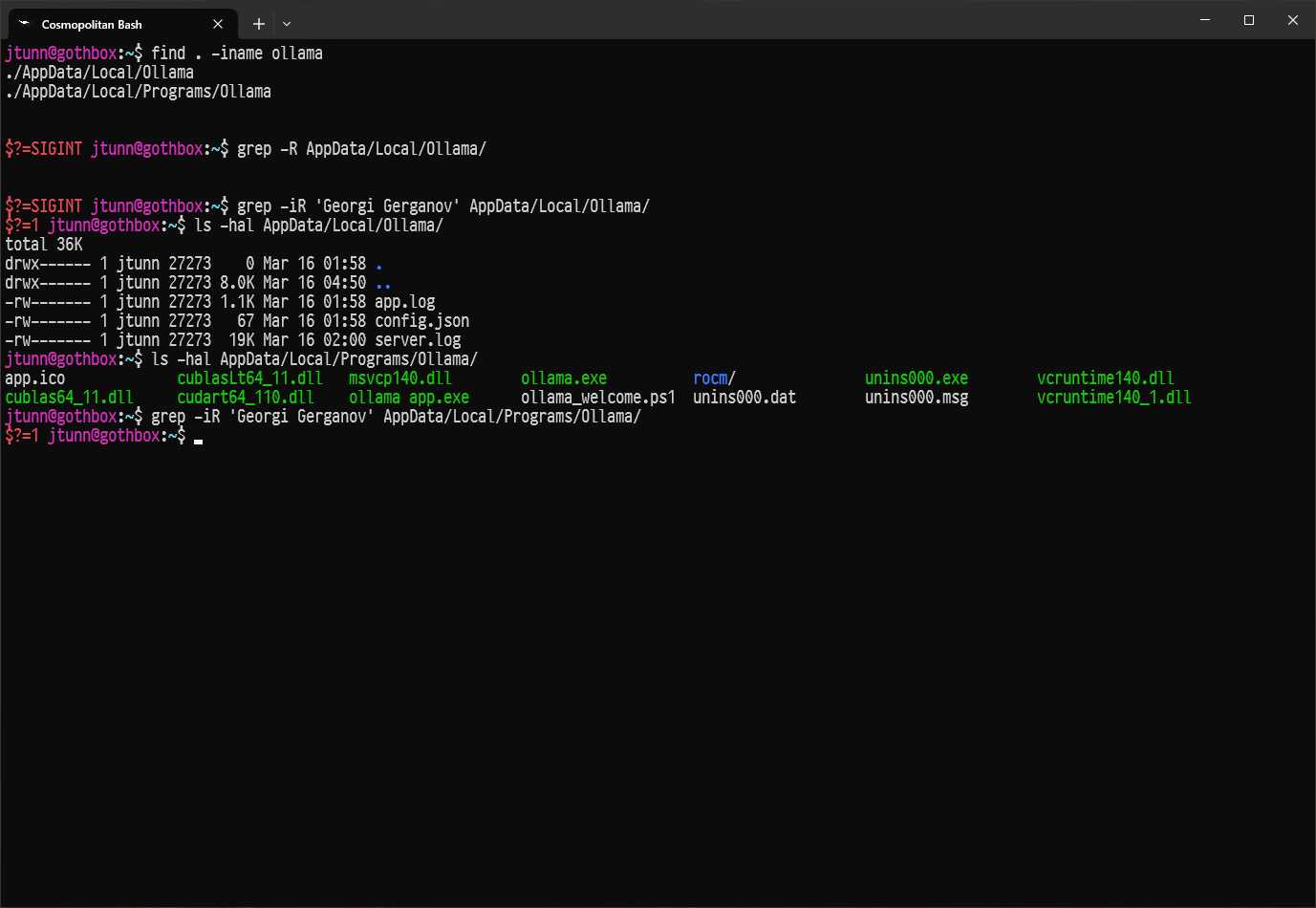
So let me install the latest Ollama on my Windows computer and see if they're doing this too. https://justine.lol/tmp/ollama-license-violation.png It would seem the answer is no. So yes, ollama appears to be violating the llama.cpp license, and probably the licenses of many other projects too. But not for the reasons we were discussing earlier.
Oops. They're violating the license on Linux too. It's also a little creepy that it used sudo on its own. So I've filed an issue here: https://github.com/ollama/ollama/issues/3185