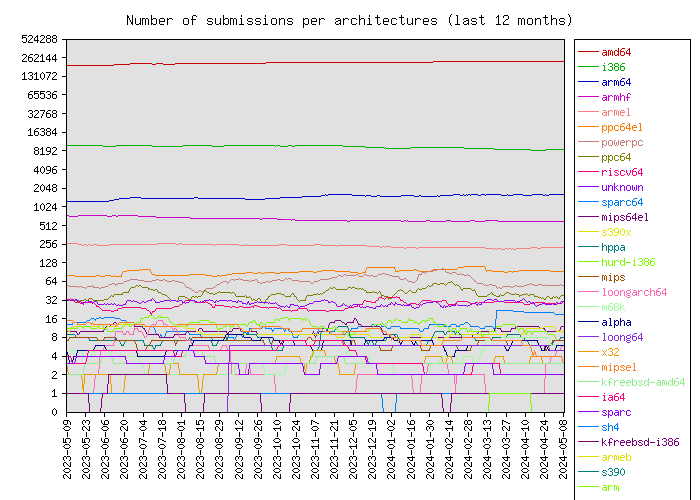
It's interesting that the project officially supports riscv64 but other architectures in a similar ecosystem niche, but vastly larger installed base, like SH4, have been unofficial ports for decades. Perhaps this is a good comparative example of how to effectively engage the community, or fail to.
There may be more hardware out there with SH4 processors, like some NAS boxes, but are they using or contributing to Debian? And when I look at a list of hardware with SuperH processors, half of the links are broken links: https://elinux.org/Processors#SuperH
SuperH seems like a niche architecture mostly supported by a single vendor and available in a few devices mostly in the Japanese market, without a huge amount of use in the Debian community.
RISC-V may not yet have as much extant hardware available, but there's tons of active development, and the open licensing model means that a lot of companies are working on RISC-V chips, which will then flow into hardware.
I'm not suggesting that SuperH would become an official port today when it is clearly dead. But the question is why it was never an official port even when it was in its prime. As for the installed base, it is absolutely terrifyingly large. They had a lot of wins in automotive, and popular consumer products like Sonos are based on it, or were for the first decade of that product line, and those products also run Linux.
Even in its prime, it simply didn't have enough interest from Debian developers for maintaining an official port.
With each release there are roll-call emails to help judge whether a port has sufficient maintenance to be included in the official release, and I generally see a single developer for SuperH/SH4: https://lists.debian.org/debian-devel/2013/10/msg00134.html
Debian doesn't sit down and do market research on amount of hardware shipped, and then allocate developers and resources based on that; they base whether there's an official port on whether there are already enough developers and infrastructure to maintain it, as builds failing on that port can block work on packages.
I am one of these DDs and also official kernel maintainer of the SuperH port. I am not responding to such roll-call messages because there is no new SuperH hardware on the horizon at the moment except for the stalled J-Core project.
Well, the current RISC-V buildds also take days to build GCC. On the other hand, the 64-bit SPARC machines have been among the fastest in Debian, yet there is no official port.
> So the answer to "why wasn't SH4 an official port" is likely "there simply weren't enough developers and infrastructure for supporting it."
I would argue that the main reason is that Renesas simply abandoned the architecture and replaced it in their own applications with ARM.
The prospective 64-bit SuperH port was dropped as well.
Yeah, I was responding to the "why wasn't it ever official even when it was reasonably popular", not why it's not now. Those threads I linked to were from 10 years ago or more.
I tried looking for any direct discussion in the past of making it an official architecture, and didn't find it, but I did find that it seems to have been slightly lower activity, and with some hurdles, and that there didn't seem to be much of a push to make it an official Debian architecture, while there's been active effort to make RISC-V an official architecture, that's been going on for several years.
Anyhow, I'm not a DD or DM, I've made a few contributions via maintainers, so you're clearly more involved than I am. I was just trying to shed some light on the question of why SuperH never was official, and as far as I can tell it's because no one ever put enough effort in to make it official, while they have done so for RISC-V. But maybe I missed some drama somewhere.
> I'm not suggesting that SuperH would become an official port today when it is clearly dead. But the question is why it was never an official port even when it was in its prime.
Because Renesas dropped the architecture and stopped paying developers maintaining it upstream.
> As for the installed base, it is absolutely terrifyingly large. They had a lot of wins in automotive, and popular consumer products like Sonos are based on it, or were for the first decade of that product line, and those products also run Linux.
That's true. But these systems were developed before Renesas stopped supporting the architecture.
I can't speak for why SH4 was always unofficial, but from a vibes perspective today, RISC-V feels like an architecture on the up. That probably helps attract more developers, and ultimately it takes people to do the work.