> The collective annual warming effect of these five chemicals on the planet is equivalent to the emissions produced by a small country like Switzerland.
> When CFCs were phased out, hydrofluorocarbons (HFCs) were brought in as substitutes. But CFCs can crop up as unintended by-products during HFC manufacture.
> The appearance of CFC-13 is much more baffling. “We really have no clue” where the emissions are coming from, Vollmer says. “We don’t know of any chemical process where this will show up as a by-product.”
>The collective annual warming effect of these five chemicals on the planet is equivalent to the emissions produced by a small country like Switzerland.
Why is warming effect what matters here? During the original CFC crisis, it was the hole in the ozone layer we were more worried about.
Because it's non-negligible source of warming greenhouse gases that is completely avoidable - we have plenty of substitutes available to us with lower global warming potential. Releasing 1 kg of CFC-13 will trap the same amount of heat as 14,000 kg of CO2.
Project Drawdown lists managing refrigerants as one of the top 10 solutions to limit warming in both 1.5 and 2C scenarios.
Yes, but the point is the danger from the warming contribution is less than the danger from an ozone hole, so why focus on the warming? Unless the ozone depletion is below the recovery rate.
The combined emissions of CFC-13, CFC-112a, CFC-113a, CFC-114a and CFC-115 increased from 1.6 ± 0.2 to 4.2 ± 0.4 ODP-Gg yr-1 (CFC-11-equivalent ozone-depleting potential) between 2010 and 2020. The anticipated impact of these emissions on stratospheric ozone recovery is small. However, ongoing emissions of the five CFCs of focus may negate some of the benefits gained under the Montreal Protocol if they continue to rise. In addition, the climate impact of the emissions of these CFCs needs to be considered, as their 2020 emissions are equivalent to 47 ± 5 TgCO2.
Both matter, though warming wasn't considered a big deal, the media was still coming away from warning about a coming ice age (i've never figured out what was going on there, as a kid I heard it more than once, but now few admit the scare existed). The ozone hole was a big deal.
Now that CFCs are banned the ozone layer is recovering. I'm guessing these emissions are not really enough to harm the ozone layer much (so long as they don't get worse!), but they add to greenhouse gases that are not in control.
" though warming wasn't considered a big deal, the media was still coming away from warning about a coming ice age (i've never figured out what was going on there, as a kid I heard it more than once, but now few admit the scare existed)."
The media lying is what happened. Either because they don't know anything about any subject and misunderstood some very non-surprising papers or because somebody was paying them to lie so people wouldn't believe on global warming.
It's hard to say how much of what reason.
And nowadays people go scrutinize the scientific papers to find the bad ones... and there aren't any. Because there were never any, the entire thing waas invented elsewhere.
There was never much scientific discussion about Earth entering an ice age. So there aren't papers there, neither good nor bad.
There was something about fixed frequency cycles on our climate, that were the source of the thing. But those don't say anything not even similar to what the press run with.
That's because anthropologists are very particular about their methodology, and which papers get accepted for peer review.
We've known about precession, but since these cycles occur in the tens of thousands of years, and each cycle is usually offset by some cataclysmic event, little actual evidence remains.
>as a kid I heard it more than once, but now few admit the scare existed.
People very rarely admit to backing the wrong horse that. Nobody will tell you they sold AAPL and MSFT stock in the 90s. Nobody will tell you they believed the racist propaganda back in the 60s. Nobody will tell you they believed Iraq had WMDs in the 00s. Nobody will tell you that they believed the people who were saying Long Island would soon be under ice in the 70s.
There was like one story in a popular science magazine once that got a lot of play, and many people heard about it because it's a vivid story. That's about the extent of it.
Climate change deniers also keep it alive because enlarging it validates their distrust of scientists.
No, the stories also made it into Newsweek and Time, which were pretty much the dominant credible news weeklies at the time, circulated to many millions of households. It's easy to look back now and say that was just sloppy work with little impact which has since been overblown, but I remember some academic authority figures in my young life taking the idea seriously a decade later as a result.
It was delivered with an imprimatur of authority from multiple sources and left an imprint for a long time.
I certainly advocated for action in Iraq in the early 2000s. I have a naive world view, informed I guess by a lot of 90s American media output, about America saving the world, Iraq was one of those opportunities.
I they hadn't totally botched it post invasion, maybe it would have worked too.
But let's see, tell 800k armed angry men they are out of a job and tell them to "go home, please don't steal any AK47s on your way out, mmmkay thanks goodbye go home and be a good boy now"
That was definitely one of the bad ones, but I think the root problem (which continues to this day) is that US foreign policy somehow manages to blend black-and-white moral histronics with an extremely shaky grasp of morality. The US can't work with moderates and pragmatists because anybody who's less than a pro-US liberal is beyond the pale, and it can't work with idealists because it spent the whole GWOT trumpeting about its torture program.
I always figured it was a Y2K style "experts make narrowly scoped statements and journalists blow it out of proportion and make it look like the world is ending" type panic. The article doesn't really look into that side of things other than to say it happened.
They both matter, and the ozone hole has started to heal whereas global warming is getting much worse. 40 years ago, the CO2 level was also only 345ppm or so compared to 420ppm today and rising much more rapidly than in the 80s, so overall warming is becoming more acute.
- Actual glaciers are melting all over the globe and ice is going down. Yearly snowpack in an isolated area doesn't contradict the global trend.
- It is called "climate change" not "global warming" because you're dumping more energy into the system, evaporating more water and stronger storms can be one result.
- California flipping from drought to massive storms doesn't cancel out, it is evidence of increasing extremes.
People have become used to the thin ozone layer. In much of the world, you now can't stay outside all day without getting sunburn. There are not many reports of sunburn from 100 years ago.
I haven't managed to find any measurements or even estimates of what UV levels at ground level were before we started making CFC's - it seems we didn't think to measure it!
Feel sorry for all the animals and plants for whom suncream isn't an option...
> People have become used to the thin ozone layer. In much of the world, you now can't stay outside all day without getting sunburn. There are not many reports of sunburn from 100 years ago.
So are you saying we evolved skin melanin production from UV radiation for no reason whatsoever? People that live in the desert used to (and still do) cover themselves with clothing just because of fashion standards?
Sunburn has been a problem for our species ever since we shed most of our fur.
Romans were believed to have a 'pale white' skin. They lived in Rome, and while there are records of sunshades (Velarium), it doesn't seem they were common. For example, the colosseum, a place people might stay many hours, had only 30% coverage.
I don't think someone with similar skin would last long in Rome in the sun today...
> A strong distinction in skin color is frequently seen in the portrayal of men and women in Ancient Rome. Since women in Ancient Rome were traditionally expected to stay inside and out of the sun, they were usually quite pale; whereas men were expected to go outside and work in the sun, so they were usually deeply tanned
There are also descriptions of treatments for sunburn.
There's no doubt that the ozone layer depletion increases the amount of UV light that we receive. Sometimes dramatically(very location dependent). But it's not like people could just toast in the sun all day without protection and not get burned.
Modern people barely spend time outside compared to the Romans. No wonder we're getting sunburnt when we finally go out in peak summer. If you spend most of your time outside year round, you'll develop a natural deep tan which offers considerable protection from the sun.
AFAIK the biggest risk of melanoma occurs from sunburn. I would guess a protective tan from regular sunlight is probably healthy overall (depending on how you get your tan: confounding benefits and risks for any activity would drown out signal?). Lifestyle risks trump melanoma risks.
People also had much lower life expectancies. I don't think it's useful to say that because the people in antiquity didn't have sun protection they were stronger or somehow immune to sunburns ... maybe they just died before living long enough for it to matter.
Or maybe they all died from cancers of all kinds, just not categorized as such, or died by murder / wars before cancer became an issue.
The vast majority of historically lower life expectancies is due to changes in death rates in the first few years. People who made it to adulthood weren't all keeling over at 35.
I'm going to politely call bullhicky on this statement. Sunburns have existed for much longer than 100 years - in fact, the first modern/commercial sunscreen was invented almost 100 years ago. Cursory searching shows that Egyptians, Greeks, Romans, etc had different methods of attempting sunscreen.
Is the sun worse now than then? Maybe, probably. But it's borderline alarmist to just declare sunburns are a recent phenomena.
I seem to remember the last time this happened the culprit was discovered to be people stealing CFC-containing waste tars from the factories they worked at, then selling them on for use in bitumen roads.
Iirc, CFCs are a unintended byproduct of a lot of industrial organic chemistry that uses chlorine - so there's an unfortunate mismatch of incentives between factories, which wish to reduce costs, politicians that want to reduce costs, and thus regulation and/or regulatory enforcement, and people who don't want a nice new melanoma.
China is mentioned as having been a likely culprit in the past. I don't understand why Westerners are so keen to make major sacrifices to quality of life in the name of fighting climate change when nothing we do will make a statistically significant impact in the long run with major population centers like China, India, and Nigeria continuing to grow more wealthy with rapidly increasing demand for reliable, 24/7 energy production, cheap air conditioning, etc.
The PCA is a joke that gives these countries essentially unlimited ability to continually move their own goalposts for "peak carbon", no real difficult sacrifices required for them until after they've reached that moving target.
China has been infamous for decades for not even having reliable currency data, what on earth makes us think they're even collecting (let alone honestly sharing) reliable data on CO2, let alone HFCs and CFCs, beyond willful naïvety, irrational optimism, and quasi-religious climate dogma demanding ideological conformance?
The harsh reality nobody on the political left in the west has the courage to acknowledge that climate change is 100% out of the control of our WEIRD (wealthy, educated, industrialized, rich, democratic) countries, and no amount of self flagellation over "climate racism", nor vicious hostility towards "climate change deniers", nor radical proposals to destroy the entire energy grid is going to make even a proverbial "drop in the bucket" difference in climate change. Climate dogma is the TSA to climate change's terrorism - wasteful, ineffective theatrical performance art that degrades everyone's quality of life while doing effectively nothing to address the actual problem, intended strictly to appease the neuroticism of the shmucks dumb enough to believe it makes a difference.
I get that this sounds pessimistic, cynical, and even a little misanthropic, but it's also what the actual data is telling us.
This isn't a fight we can win with the way things are done in China not changing. Totalitarian demands for ideological conformance present an impenetrable barrier for "real" progression of humanity in virtually every aspect in every country where they are practiced, including the climate change cult itself in the US.
I mean what do you propose western nations do? Nothing? Yeah stupid measures like removing straws from restaurants make 0 difference, but pushing for more fuel efficient vehicles and cleaner sources of electricity seems like a worthwhile effort without much QoL sacrifice. Green infrastructure (i.e. reducing car dependence) also seems to improve quality of life in many places, so I would argue we should be trying to do that regardless. Also don't dismiss that doing these things puts international pressure on developing nations to clean up their energy as demand increases. Western nations can't demand that the rest of the world reduce emissions until they do first. Reducing carbon domestically is necessary to try to reduce it abroad.
Start with those where the environmental impact is best known and understood.
Impose escalating tariffs on those items from any nation not meeting those goals.
We will buy less or they’ll be made more cleanly. Worst case making them in countries that make them cleanly eventually becomes profitable with the tariff protection.
You could do all of them and give companies time to adjust their supply chains. I'm sure given such a sweeping order, supply chains will reorient rapidly to other places.
> Western nations can't demand that the rest of the world reduce emissions until they do first.
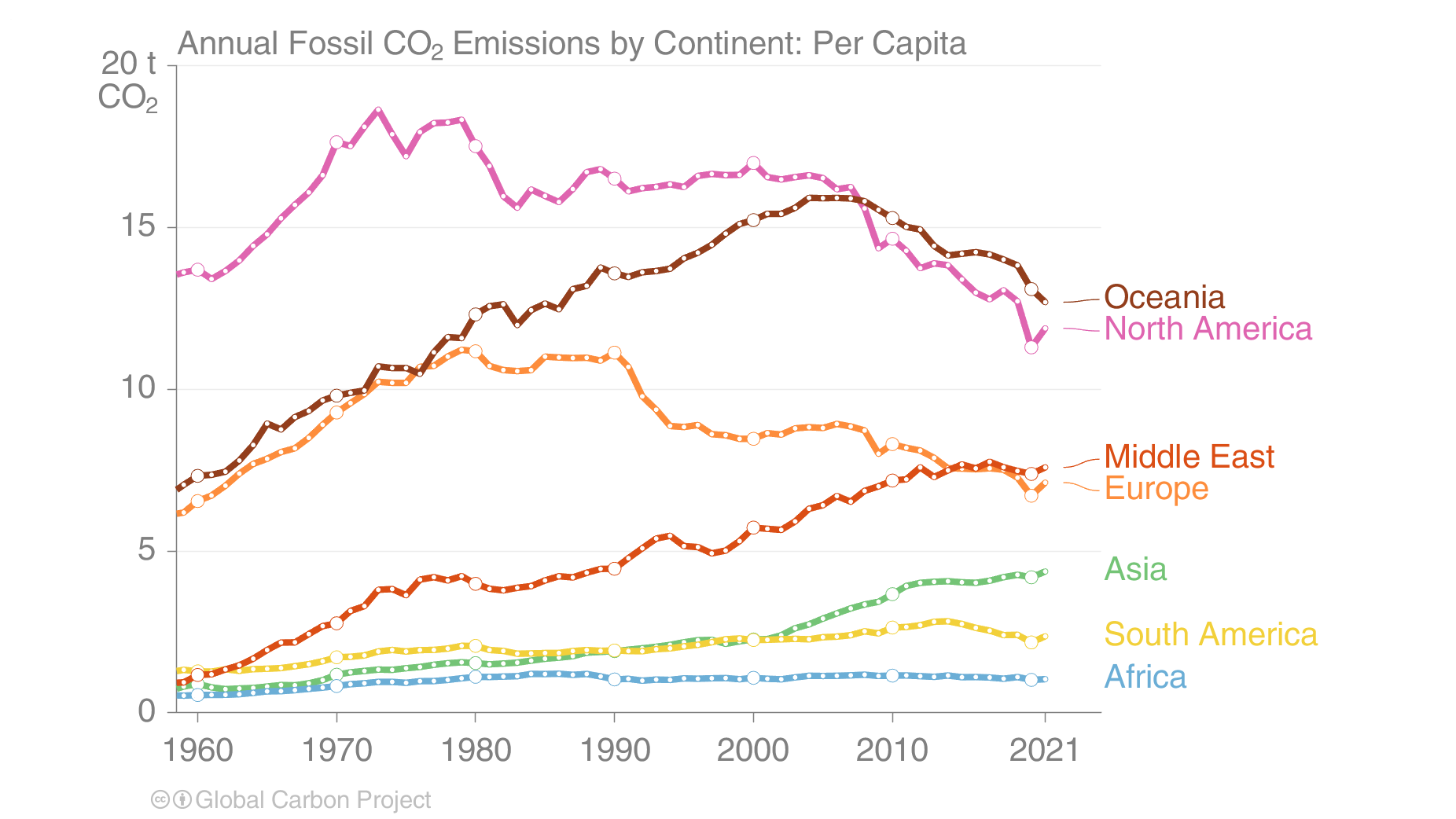
The west is working hard at lowering it's emissions, but all that work is getting undone because China's emissions aren't slowing down. Coal is incredibly cheap when there's no carbon tax or emission standards. One of the many reasons it's cheaper to manufacture in China and why North Americans and Europeans can't compete [0]. Comparing the US[1] and China[2], the US has:
- Decreasing per capita emissions in the US starting in 1973 (-27%)
- A decrease in the countries emission starting in 2007 (-13%)
Meanwhile for the same period China has had
- a 7x increase per capita since 1973 (+532%)
- 48% increase for its global emissions since 2007
So it is possible to drastically reduce our carbon footprint thanks to innovation and smarter power generation.
Time to add tariffs on goods produced by states who made the decision of going all-in on polluting power generation, and potentially apply immigration quotas to citizens of these countries.
Yes they are so perhaps that was a strawman, if you will. I could equally have made the point with "sustainable" versions of inherently unsustainable products or any manner of surface-level "environment-friendly" change.
If it was really about that, you'd think they'd force starbucks to sell you a cold drink in a paper cup instead of what is basically a giant straw you can't locally recycle anyhow.
How do you diplomatically convince another country that their people need to have a lifestyle and standard of living that emits a fraction of the CO2 that your people emit?
The current US lifestyle has CO2 emissions per person 2x that of the current Chinese lifestyle, and over 8x that of the current Indian lifestyle.
Total emissions from India is 1/2 US emissions and total from China is 2x US emissions, but switching to per country instead of per person doesn't really help because the US is the #2 emitter by country (we are #16 per capita).
Does it? The US is currently compelling Russia to give up its claims in eastern Ukraine, despite occupying whole parts of Syria and other places itself
>"The Syrian Arab Republic affirms that the practices of the United States of America and the illegal presence of its forces on parts of the territory of the Syrian Arab Republic is an actual embodiment of the crime of aggression," the Syrian Mission to the United Nations told Newsweek.
>"Syria stresses that the lies promoted by the U.S. administration are nothing but a failed attempt to justify the acts of aggression and the flagrant violation of the sovereignty, unity, and territorial integrity of the Syrian Arab Republic,"
Not every culture values virtue signaling as much as the current regime in the west; performative acts are not necessarily going to influence other cultures such as China, etc.
I agree. China is either going to require us to find a real diplomatic solution, or get so good at producing technology that removes carbon from the environment sustainably, at scale, that we can simply suck up other countries' excess carbon. Either way, these will be expensive and the political will for such solutions is probably not here in our current political system. I commented further down about needing to address political corruption first and foremost (removing "lobbyists", overturning CU, etc) - I think this will be an important step in producing a political system that will even allow us to effectively address climate change in the first place.
I think it's pretty clear that the only two outcomes of this scenario are societal destruction via climate catastrophe or we find a way to cleanly 1000x our energy production.
Nixon wanted to have 1000 operating nuclear reactors in the U.S. by 2000. Today we have 92 of them, which power 8% of our electricity demand. Making the assumption that those other 918 reactors we would have had generate the same output as these, we could have been almost entirely powered through nuclear energy today had nuclear energy not seen pushback over the last 50 years. Instead, c'est la vie
They are not really competing for the same material. Fission smashes neutrons into big atoms to make them smaller, fusion smashes small atoms into each other to make them bigger. Both work by making atoms of the more stable medium-sized variety, and extracting the energy of that process.
But yeah, looks like commercial fusion reactors are getting closer.
This sort of ignores the global nature of our supply chains though. Someone can be very green in life here in the EU because all the products they buy are manufactured in China and their environmental impact is externalised and put onto the stats of another country that's trying to meet our demands.
By regulating what's available on markets here we can pressure maufacturers elsewhere.
What is the alternative you would suggest? We have no direct regulatory power over anyone but ourselves.
I understand that pointing out problems in complex systems without proposing a solution is ultimately indifferent from eloquent bitching, which I can certainly be fairly accused of.
That said, what the west is currently doing to address climate change - analogous to cheering for the people trying to push a derailed 130-ton freight car back onto the rail tracks with unassisted manpower alone - is not a solution either.
The first step towards a real solution is recognizing that what we are currently doing is a categorically pointless waste of time, so we can stop wasting energy and thought on that and start diverting it to actual solutions.
If you think that nothing we are doing could possibly help, you are ignoring the power of exponentials and economies of scale. Besides, a planet with colossal amounts of solar/wind/battery/nuclear production capacity left over from a developed world ramp is in a much better place to help the developing world than one without.
> stop wasting energy and thought on that and start diverting it to actual solutions
I thought you didn't have any actual solutions and admitted as much?
I don't think you're giving the west a fair shake here.
The work the west(and China) is doing to develop non-fossil fuel based tech cheap is directly applicable to those growing economies, and not a pointless waste of time.
I think its right to point out the particular futility here, but I also think that it is a mistake to attribute it all to a "mistake" or particular irrationality of the West as a whole.
These things appear to us a "pointless" and a waste of time because there are overriding economic principles we just don't want to touch, it is a willful pointlessness that is quite apparent in the big picture. It's not China, it's capitalism, (of which, granted, China is a huge agent within).
If we lived in a world where the problems were simply about the distribution itself of food and shelter and power, we could point to the complexity of the systems, and understand the risks of wrongheadedness in the face of them, but we live in a world plagued by bad faith and non-human incentives that certainly muddy these waters, but it doesn't mean there aren't some simple solutions to a few things people haven't thought of...
To create this dichotomy between the West and China is to deny the Anthropocene we are all in! One that is defined necessarily by the literally geological forces of a world-dominating economic order.
You are a very good writer and I’m intrigued by this thread. Can you elaborate on what you see as actual solutions and how they would look (no matter how far fetched)?
Thank you for the complement. I'm under no delusion that I have the solutions to the whole world's problems figured out. These ideas are like unrefined chunks of coal, rife with imperfections and riddled with flaws and only under the great pressure and heat of vigorous, critical debate may they ever hope to become diamonds.
I think R&D on the scale of what the US spent relative to GDP during WW2 might be a place to start. That's economically likely to require severe and heavy cuts across the board and may require a transformation of what are seen as the traditional roles of government. Half of all spending in the US goes to social security, medicare, and medicaid. These three programs combined take up almost triple US military spending. What's worse, they're mathematically unsustainable. Social security and medicare are effectively pyramid schemes that are running out of new people to recruit (result of low birthrates, dramatic improvements in life expectancy, and the lowest rates of net immigration into the country, as a % of existing population, in this country's history). These programs are going to die sooner or later anyway, why not rip off the band-aid now and start putting that enormous spending towards solutions for problems that can save billions rather than millions?
At the same time, there probably needs to be major overhauls to the US tax system. Even when top marginal rates were close to 90% last century, large corporations effectively bought politicians to create enormous tax write offs for them. As a result, total federal government receipts as a percent of GDP have never left the range of 16%-26%. Let's consider a flat federal tax rate of 27% across the board, with only one category of write-offs: R&D for carbon-negative / climate-healing solutions (as opposed to carbon neutral / climate-unaffecting solutions). We're going to need to be capable of removing other countries' carbon emissions if we fail to get them on the same page diplomatically or militarily, and I will never support military intervention (read: mass murder of innocent civilians) as a solution.
Imagine the sheer power of the US government being deployed full-force, with such overwhelming financial backing that we strive to go so deeply carbon negative that it doesn't even matter whether India and China are on board or not.
Yes we would be giving up the fights on a lot of problems, but IMO, no problems other than climate change and nuclear conflict between superpowers threatens the whole of humanity. While not perfect, the nuclear superpower problem is not getting worse as quickly as climate change, so on some level it makes sense to go full-steam-ahead on resource allocation to the largest issue first, and then work our way down the chain to smaller ones, rather than overextending ourselves and failing to solve problem #1, like we're doing now.
These are obviously some pretty radical proposals and I don't think there is political will to even have anything remotely like this seriously considered, so our corrupt, money-influenced political system probably needs to be changed first.
Just like how FTP separates the data plane (political outcomes) from the control plane (political process), we too need to protect the control plane from adversarial influence (big corporation lobbyists, citizens united, etc) before we can ever hope to achieve meaningful political outcomes.
Accordingly, whatever solves the political corruption ("lobbying") problem first should probably be our first step.
The usual response is that this would be economically suicidal for the US, and that other ambitious competitors would attempt to create a new world order more suited to their preferences. This would probably anoint China as the next century's global hegemon, although it's at least equally likely that the world would devolve into warring fiefdoms as the world economy imploded.
Tens or hundreds of millions of people would die as a direct consequence of this economic malpractice, including a decent portion of the US citizens who voted for the persons responsible. Reelection would be tricky, although it would not be difficult to imagine the US democratic process being suspended as a reaction to the catastrophe (legal precedent is not relevant, see history).
Don't get me wrong: climate change is a problem! But this would create a much bigger and more acute problem.
> so we can stop wasting energy and thought on that and start diverting it to actual solutions.
If there were better "actual solutions", stupid moonshots wouldn't get funded in the first place. I don't think your framing of this situation is very accurate.
Do the difficult thing. Stop buying from China. As consumers, buy things with a transparent supply chain. Look for ESG reports on the companies you buy from.
The hard part of this is it requires consumers to be educated and act. This almost never happens unless the costs for not acting are built into the prices of goods. Doing that requires political will. It's going to make a lot of people very angry; and we're not talking indulgences in the form of cap & trade, either.
>The hard part of this is it requires consumers to be educated and act.
Agreed 100%.
>Doing that requires political will. It's going to make a lot of people very angry; and we're not talking indulgences in the form of cap & trade, either.
Also an astute observation. It may be the case that this is ultimately a problem with our political system first and foremost.
But economic sanctions alone will not halt the manufacturing base of an economy the size of China's.
China and India need to get on board for real. Asking politely is not working. I'll never advocate for the initiation of force, but something is going to need to change in a big way to convince these countries to join us in a fight that will strip all of us of a little short-term prosperity, if we want to leave a planet that our great grandchildren can safely habitate.
I might suggest the slightly less difficult thing that I think could be reasonably politically accomplished. Introduce carbon tariffs on goods imported from dirty countries to make their products less competitive and provide an incentive to clean up manufacturing.
I want to go one step further than this idea and introduce carbon tariffs on imported goods coupled with price ceilings so corporations can't pass off the tariffs to wealthy people and still profit. The corporations should be paying these taxes and their bottom line should suffer if they're selling dirty goods. They should not be able to make the profit margins they're making today by manufacturing cheap trash in China and selling it for insane markups in first-world countries.
The price ceilings should be set based on some amount of maximum profit margin companies should be allowed to make. If they want to make bigger margins they're going to have to move manufacturing to cleaner countries and then they can apply their insane markups.
I'm actually quite in favor of, essentially, a minimum VAT tax. The US demands that good manufacturing pays some reasonable level of VAT taxes (let's say 10% as an example). If Apple builds a laptop in China they value at 300$ (paying 45$ in VAT to China) and then ship it over to Bermuda to "endow it with their brand" adding 1700$ to the value and paying a VAT tax of .5% then, once it arrives at US shores, we simply bar the good entry until 9.5% of 1700$ is surrendered to the US government to account for VAT dodging.
It's an incredibly easy way to close a whole bunch of tax loopholes at once.
So, an import tariff that is waived against imports from countries with sufficiently high taxes on production, provided those taxes are characterized the right way?
Seems like a monumentally bad idea
> It’s an incredibly easy way to close a whole bunch of tax loopholes at once.
Tax compatibility is a pretty solved problem - countries frequently coordinate to make sure income and other taxes don't end up being double counted so it's not like this would happen accidentally[1]. And the point isn't so much that the US should collect all this revenue - it's just to make tax havens moot and unnecessary.
Why spend money shipping laptops to Bermuda so you can put a sticker on them there if you aren't saving any money?
1. There's a positive incentive here, if you work and live in country A and are considering working in country B either country B can craft their tax system so that you won't end up paying the same taxes to both country A or country B... or they can not do that. If they fail to make their tax law compatible they lose out on your tax income (it instead all goes to country A) since nobody wants to be double taxed - if they make their tax laws compatible then they essentially get some free income and another earner. Digital nomads pulling down six digit salaries in low cost of living countries also injects a whole lot of money into the local economy and generally just makes things better - and the country retains the right to limit visas if they ever have any issues with it.
Tax compatibility with VAT only is a sensible concept where the destination country has a VAT itself, which the US does not. Otherwise, a minimum VAT on imports is just a global punitive import tariff, and has nothing to do with compatibility.
Even where its sensible, it still has potential problems that can be introduced through other parts of the tax system, but…we don’t really need to consider that in this case.
Great baby step. I'm all for it. Let's just make sure nobody is under the impression that this is anything more than a baby step - far more will be needed, ultimately.
Produce political solutions that steer the market towards developing electronics domestically again, or reducing the need for such electronics in the first place.
> This sort of ignores the global nature of our supply chains though.
To me the answer is a pretty easy one:
Take the CO2 emissions of a country and divide by its GDP. That gives you a CO2 per dollar. Then decide on a CO2 cost per unit for your country. Now apply that as a tariff per dollar of imports from said country.
It's imperfect, of course. But I think it is close enough to estimate what we want it to do.
We don't have to trust their numbers, we have satellites that can monitor the emission levels.
The US pollutes at roughly twice the amount on a per person basis as China. In addition we "outsource" some of our pollution to them by them doing our manufacturing.
It's tough to both raise the standard of living (reduce poverty) while also reducing pollution but China has a lot of initiatives to be more green; for examples 150 new nuclear reactors planned in the next 15 years. They benefit from the better air quality so it's a goal for them.
We do have a worse starting point, but as another commenter has pointed out, we're trending in the right direction and China is trending in the wrong direction.
Part of the solution is necessarily going to be temporary reductions in American energy consumption, writ large, until we can produce technology to sustainably remove carbon emissions from the environment at scale. I'm all-in, for instance, on banning SUVs and "light" trucks for personal ownership, which categorically require more energy input (regardless of whether gasoline, hydrogen, electric, etc) than sedans and compact cars - to say nothing of the pedestrian safety risks, no less.
Hell, I'm open to considering energy quotas for residential homes, to be reduced to a level sufficient only for the sustainment of life past a certain threshold, to disincentive wasteful use of electricity.
These are all tiny steps in the right direction, and all insufficient alone, but our progress in saving the climate is a vector value, not a boolean value. A bunch of little improvements in the right direction do help, but we cannot accept them as a "complete" solution on their own.
"to be reduced to a level sufficient only for the sustainment of life past a certain threshold," Wow, do you hear yourself? Who decides what "threshold" is acceptable, you? You think you should be able to determine whether my infant daughter freezes in the winter or swelters in the summer? Oh I'm sure your theory involves some utopian government that never gets anything wrong.
What you're proposing is a dystopian police state where the government decides how warm or cold your house should be on any given day. Of course the rich will be able to just pay any fines to keep the power/gas on, so they can blast their AC all summer while the poor swelter or go into debt to pay fines, because their house unfortunately isn't built in the shade and gets hotter than the ones around it, so the government weather stations think their house is cooler than it actually is. Or the government will have to put thermostats in literally every house to accurately monitor internal temperature, and decide what's good enough for you.
Why not grocery rations while we're at it? The government will assign you the number and type of foods you're limited to, namely the ones that produce the least carbon emissions to produce and with the caloric and nutritional profiles determined by the government to be ideal. Would cure obesity as a side effect!
Also housing will be limited to a certain number of sq ft per person, any existing property with a footprint exceeding that number will be seized and turned into multi-family housing, with government-determined "fair" compensation to the existing property owner of course.
Both of those ideas follow the same priorities and rationale as your energy quotas.
Shit like that is the real reason why the second amendment exists. You're probably just wealthy enough that you assume you'd be among the ruling elite that maintains its personal freedom, or you really haven't thought these ideas through. I'm far less worried about climate change, something we can at least potentially adapt to at cost, than I am about rhetoric like this. It's akin to the Chinese Nationalists opening the Yellow River dam in 1938 in an attempt to slow the Japanese advance. The resulting flood killed between 400,000-900,000 civilians directly depending on who's counting, made millions more homeless, and ultimately did little to slow the Japanese advance. But I guess it was a "tiny step in the right direction" from a war-fighting perspective, right?
>What you're proposing is a dystopian police state where the government decides how warm or cold your house should be on any given day. Of course the rich will be able to just pay any fines to keep the power/gas on, so they can blast their AC all summer while the poor swelter or go into debt to pay fines...
>Why not grocery rations while we're at it? The government will assign you the number and type of foods you're limited to...
>Also housing will be limited to a certain number of sq ft per person...
Spoiler: how rich you are already determines how warm/cold your house is allowed to be, and how large it's allowed to be, and the foods you're allowed to eat.
To a point, but there are payment plans for people who can't make their utility bills, there are charities and soup kitchens for people who are food insecure. Also welfare and food stamps. It's not a perfect system by far but there's at least some semblance of a safety net. Also the government doesn't directly dictate how much you eat or the precise temperature of your house. If you run out of resources, the government gives you a minimum. You still have the freedom to acquire more resources if you're able, in fact it's generally expected that you try.
What these proposals are talking about is forcing people to live in poverty by government mandate to fight climate change. (So much for the war on poverty I guess, now poverty is the solution!) It's about putting a hard, government enforced ceiling on the level of prosperity one is allowed to earn, and making that ceiling lower than most peoples' current living standards. All so one individual nation can fight climate change, because there's no way the entire world is going to agree to this.
After centuries of democracy and prosperity, people will kill over that, and they would be right to. It's also ineffective and unnecessary. The amount of carbon saved would be offset by the massive internal security and enforcement departments needed to achieve any of this, and it would stifle innovation as the social/cultural motivations that encourage it in the populace are removed by government mandate. It would also kill the economy and consequently make governments poorer due to the loss in tax revenue.
I'm pretty left by American standards, but I believe in American founding principles. If that shit ever starts I'm going to be dealing in illegal wood-fired generators, and helping the more militant resistance properly encrypt/secure their communications until such time as the government is overthrown. But democracy still works here, so thankfully I can be confident enough that's never going to happen that I can post about it here.
>but there are payment plans for people who can't make their utility bills, there are charities and soup kitchens for people who are food insecure. Also welfare and food stamps. It's not a perfect system by far but there's at least some semblance of a safety net.
Don't make me laugh.
I take it you've never actually needed to use these services? Because their 'availability' is increasingly unavailable due to bogus eligibility criteria, bureaucratic gridlock and delays, transport unavailability, etc.
The apparent presence of these services is just a pernicious lie pulled over the eyes of the well-off, in the same way that Law and Order and other 'cop-aganda' TV shows disarm their outrage about the justice system. The well-off are the only ones with the power to change the system, so (predictably) they're subject to extensive propaganda along these lines.
>Also the government doesn't directly dictate how much you eat or the precise temperature of your house.
Right. The economy is better because it generously gives you the choice of... heat or eat. Such luxury!
That distinction means you're just fine with it, apparently. So no doubt a government program that affords people the same luxurious choice should pass your muster, correct? :D
The alternative is that we do nothing until it's too late, and then the consequences will be much worse. Don't worry though, society is terrible at preventive action, so I'm pretty confident we're going for the reactive action once it's too late.
The thing we have to do is innovation. We need cleaner, cheaper tech. There are some regulations we can implement to incentivize that, but we're not going to conserve our way out of climate change with our current technology, not unless you're willing to sacrifice democracy and Western society itself to do it. And even if you are, good luck getting the rest of us to go along with it.
I'd much rather endure the effects of climate change than literally create a dystopian New World Order out of science fiction.
The trends are the US is reducing emissions. I'm not sure what China us doing (I know they build a lot of solar, but i'm not clear if they are also building coal power plants)
They are building, buying, and using a lot of coal, but that's mostly a temporary regression in their environmentalism from a significant economic reduction. Remember, at one point they were literally closing their airports because it's too smoggy to operate safely. China will reduce their fossil fuel usage even if global warming was not a concern, simply because they don't like the lost productivity and societal happiness that comes from breathing so much smog.
For whatever upper limit we finally decide we must keep warming under there will be a corresponding total amount of greenhouse gases that can be in the atmosphere without pushing warming past that limit.
Since the atmosphere does not care about arbitrary man-made boundaries it makes no sense to do an unweighted comparison of the emissions of different countries when trying to decide which countries are emitting too much and need to cut back and which countries are using less than their fair share and can still expand.
One way to see this is to look at what happens when a country splits in two. With an unweighted comparison for determining shares any country that is using more than its share could split into smaller countries. The union of those smaller countries would still be emitting at least as much as before but it would move the finger to point at someone else.
The sensible comparison is to weight by population, with adjustments for trade to account for countries outsourcing their emissions to others.
India is around #130 in emissions per capita. Nigeria is around #170. They are both currently way below their fair share. If India and Nigeria as part of growing more wealthy needed to increase their emissions to the same level as Brazil, that could be offset by the US cutting emission by a mere 10%.
If you’re going to create a quota for countries, it’s not obvious that you should allow credits for outsourced emissions. If a country wants to use its previous quota on trade, it can but it gets no credit excusing it.
The factories that make solar panels and wind turbines for us today will make solar panels and wind turbines for the rest of the world tomorrow, and also more factories in between now and then.
> make even a proverbial "drop in the bucket"
These drops in a bucket are exponential. What did your mother teach you about exponentials?
> the way things are done in China not changing
China is making solar panels and nuclear reactors like the future depends on it. They are part of the problem, yes, but they are definitely part of the solution too.
> climate change cult
Wanting clean air and tame climate is "cult" behavior?
As far as the cult goes, I think they probably mean the “we have to tear down the economy and re build it to address climate Justice” and “any sacrifice is worth it in the name of climate change crowds”. Of which a large number just pay lip service, but there are still a lot of true believers.
It's almost like solving this problem gets harder and harder the longer we put it off.
If only we knew this was a looming problem 40 years ago and started doing something about it back then. The total economic cost would have been much lower.
And the scary thing is, the cost of climate change is only going to get worse. Eventually we will reach a point where the cost is unavoidable, and we will be spending trillions dealing with the consequences rather than billions preventing them.
There is a reason our own military pegs climate change as one of our biggest national security risks in the 21st century, because things are going to get very ugly when large populated regions of the world become inhospitable.
I would be much more sympathetic to these concerns if I saw credible green extremist policy pushes of the kind you describe, but the extent of green policy so far seems to be... EV subsidies for Elon Musk.
No, right now green extremists are primarily just bogeymen invoked by the usual conservative causes. I just don't feel a pressing need to jump into this fight on the side of legacy energy. Not yet and probably not ever.
This is precisely my criticism of that crowd. They aren't proposing real solutions, just "EVs everywhere!" while EVs are ostensibly not even a fully mature technology the way ICE's are yet.
> I don't understand why Westerners are so keen to make major sacrifices to quality of life in the name of fighting climate change when nothing we do will make a statistically significant impact in the long run with major population centers like China, India, and Nigeria continuing to grow more wealthy with rapidly increasing demand for reliable, 24/7 energy production, cheap air conditioning, etc.
Because we still all gotta share this earth together, and destroying it faster helps no one. How is that difficult to understand? Do you honestly think that just going "fuck it, let's keep polluting because other people are doing the same" is really going to get us to a better place?
> I don't understand why Westerners are so keen to make major sacrifices to quality of life in the name of fighting climate change when nothing we do will make a statistically significant impact in the long run with major population centers like China, India, and Nigeria continuing to grow more wealthy with rapidly increasing demand for reliable, 24/7 energy production, cheap air conditioning, etc.
Can't convince the others to do it if you don't do it.
Is the strategy of doing it ourselves and politely asking China and India to get on board this century working so far?
I'm not saying we shouldn't be taking steps to reduce our carbon footprint in the west, I'm saying that doing that and hoping that other countries will voluntarily join us isn't working.
>Is the strategy of doing it ourselves and politely asking China and India to get on board this century working so far?
Yes.
Western shifts to less-harmful methods and materials increases the size of the market for those methods and materials and lowers their costs, spurring adoption in places not as rich as the West.
The early adoption of solar panels in the west drives production capacity in poorer nations that are more manufacturing-oriented. The increased production capacity increases supply, which lowers prices, which makes it more affordable for them to transition to solar (and other technologies).
International conventions, treaties, and agreements headed by richer nations bring along poorer nations.
In the US, harmful emissions like CO2 and GHG plateaued in the 70s and 80s and started declining on both a total and per-capita basis in the 2000s. They are still much, MUCH, higher than the rest of the world but are declining. In China and India emissions have started to slow their rate of increase or have plateaued in the last 10 years.
China went from ~5% of their energy coming from renewables and nuclear in 2000 to 15% in 2019. The US was at approximately 40% in 2020. Given the rates of change China will probably surpass the United States in renewable/nuclear generation as a percentage of their electricity generation in 10-20 years.
I would expect the emissions curves to mimic those of Europe and the United States, lagging by 30-40 years.
This is a decades-long effort, not something that can be realized in years. The infrastructure built 20 years ago still has 30 years left in it, so the targets we want to hit in 50 years need to be planned for and built today.
But as for your question "the strategy of doing it ourselves" isn't really valid.
Each individual American emits roughly 3x the amount of CO2 that a Chinese person does. We're not "doing it ourselves" we are barely sacrificing anything while expecting people poorer than us to do what we don't want to do.
Absolutely. Wealthy nations like ours investing heavily in renewable energy makes the technology cheap enough that fossil fuels stop looking attractive even to poorer nations.
Realistically, China is playing both sides here and everybody knows it. On the one hand, they know there's no real political consequence for polluting yet - they're happy to loot the commons as hard as they can.
On the other hand, China is also investing a furious amount of money into green tech, doing multiple moonshots at a time on this stuff. So when the world does start to enforce standards globally, they'll be in the winning position.
So in this era where nobody is putting in an earnest effort on climate change, they're winnning... and the day we switch over to caring and enforcing the rules globally, they'll keep on winning.
We’re already seeing countries decouple their economic growth from CO2 output (even after accounting for offshoring)[0]. Coupled with the fact that green technologies like wind and solar are either cheaper, or cost competitive with fossil sources of energy, plus the history of developing countries leap frogging up the tech tree (for example many African countries jumped straight to mobile banking). There’s absolutely no reason to believe that developing countries will cause anywhere near the same levels of environmental damage as western countries did during their development.
Additionally, western countries could just pay developing to use greener tech, covering extra cost’s needed to build carbon neutral economies, given western nations have profited enormously from their exploitation of the natural environment.
To believe that climate change is hopeless problem, and that solutions could not only be developed, but already exist, is pointlessly cynical and counterproductive. Rather than explain why we’re all doom, you could instead do some research and learn about the interesting work going on to solve the exact issues you mention.
If you look at cumulative historical emissions, whether CO2 or HFCs, it is the West that produced the majority of the pollutants that is currently in the atmosphere. The west, therefore should bare the majority of the responsibility for their actions since they produced this tremendous externality when they were industrializing.
It sounds like you're arguing we should be cool with China destroying the environment because some other countries already damaged it. Am I understanding your argument correctly?
They don't need to come anywhere near US levels of per capita emissions to stop being poor. Here are some countries that are generally considered to be reasonably wealthy, and their per capita emissions as a percent of US per capita emissions:
They are just as much looking to leapfrog and have opportunities to do so. Without massive numbers of oil and coal lobbyists, as just one example, it is far easier for them to jump straight into massive renewable energy sources and skip a lot of Western CO2 mistakes in their "bootstrapping" processes.
>China has been infamous for decades for not even having reliable currency data, what on earth makes us think they're even collecting (let alone honestly sharing) reliable data on CO2, let alone HFCs and CFCs, beyond willful naïvety, irrational optimism, and quasi-religious climate dogma demanding ideological conformance?
Was going to say... I would guess/hope that combining chemistry and meteorology would allow researchers to measure samples of air outside China's jurisdiction and come up with reasonable estimations of any emissions they are omitting.
The ban on CFCs has been a huge success and likely prevented an awful lot of melanoma.
It's a similar story with leaded gasoline.
I'll never understand this argument. "Why should we care about our health if {insert poor country here} doesn't care about theirs"? It's just a convenient excuse to keep making the problem worse and worse. The correct solution here is to find the culprits and pressure them into complying with international goals, not just give up and turn the Earth into an inhospitable furnace.
> nothing we do will make a statistically significant impact in the long run
We've already reduced estimated warming from ~6 degrees to ~3.5 degrees or so. It's not enough, but it's a hell of a lot better than statistically insignificant.
Why would you think that China doesn't care about climate change? It's going to affect them too after all. Per-capita, the US is still by far the biggest emitter of greenhouse gases in the world.
This is historically more of a right-wing phenomenon in the US. Though I concede it is becoming stronger on the left in recent years, as their frustration boils over. Seems they've finally concluded that the right wing will never be coming to the table in good faith, so might as well fight fire with fire.
This is not what I am advocating for. To be unequivocally clear, I absolutely do believe in man-made climate change, and that the solution to it cannot be found down the path of ignoring it.
The article implies something different: that it was lucky they were so easily able to track the first CFC-11 incidents:
> Scientists got somewhat lucky with CFC-11: monitoring stations equipped to detect that particular chemical happened to be located relatively close to the source.
Assuming the global monitoring can track the source (if it was intentional or not), is not based on information from the article.
> This is what happened a few years ago, when researchers detected high levels of CFC-11 in the atmosphere2, and traced them to eastern China3. They deduced the source on the basis of readings from monitoring stations in South Korea and Japan, reporting it in May 2019, and afterwards, levels began to fall. Scientists got somewhat lucky with CFC-11: monitoring stations equipped to detect that particular chemical happened to be located relatively close to the source.
I'm surprised this isn't measured more frequently after the CFC crisis we had back in the day. Also, very puzzling that they have different theories for different CFC's... surprising to have independent trends causing this?
I find that the US is very lenient when it comes to inspecting environmental practices. What is it, most oil rigs get inspected 5% as often as they should? I forget the number, and I'm just quoting some movie... someone will know, but it was a very small number.
China shows a blatant disregard for the environment.
Russia also seems to have no concern for environmental protection.
India may not have the financial means to prioritize environmental protection.
It's likely that some places that previously used banned chemicals simply hoarded them or purchased them at a lower price once other countries began enforcing bans.
It's not surprising that banned chemicals are still being used, and the same will likely happen with gasoline.
As we shift towards electric vehicles, the price of gas will decrease, making it more difficult to move away from petroleum-based products. As a result, anyone still "developing" will inevitably use more petroleum than they did before.
It's disheartening to say, but we're in a tough spot when it comes to the environment. I can't really envision any scenario in which short-term greed (even spanning one lifetime) doesn't destroy humanity.
And are we even able to transition off petroleum? States like California and Texas already have massive power grid issues.... and that's with sub 5% of the vehicles drawing power.
Think a Republican President would have even paused to make sure his pen worked before approving the Willow Project? Pretty hard to go against a state that overwhelmingly wants more jobs.


> When CFCs were phased out, hydrofluorocarbons (HFCs) were brought in as substitutes. But CFCs can crop up as unintended by-products during HFC manufacture.
> The appearance of CFC-13 is much more baffling. “We really have no clue” where the emissions are coming from, Vollmer says. “We don’t know of any chemical process where this will show up as a by-product.”