It strikes me as an outsider that Intel's issue has not necessarily been lack of talent but rather more of an internal processes and politics issue. The company's offerings have felt really disjointed and it hasn't felt like the company has been rallying behind unified goals.
Anecdotally, lots of Intel engineers have also been leaving due to frustration of getting things done and pretty poor compensation compared to the rest of the industry.
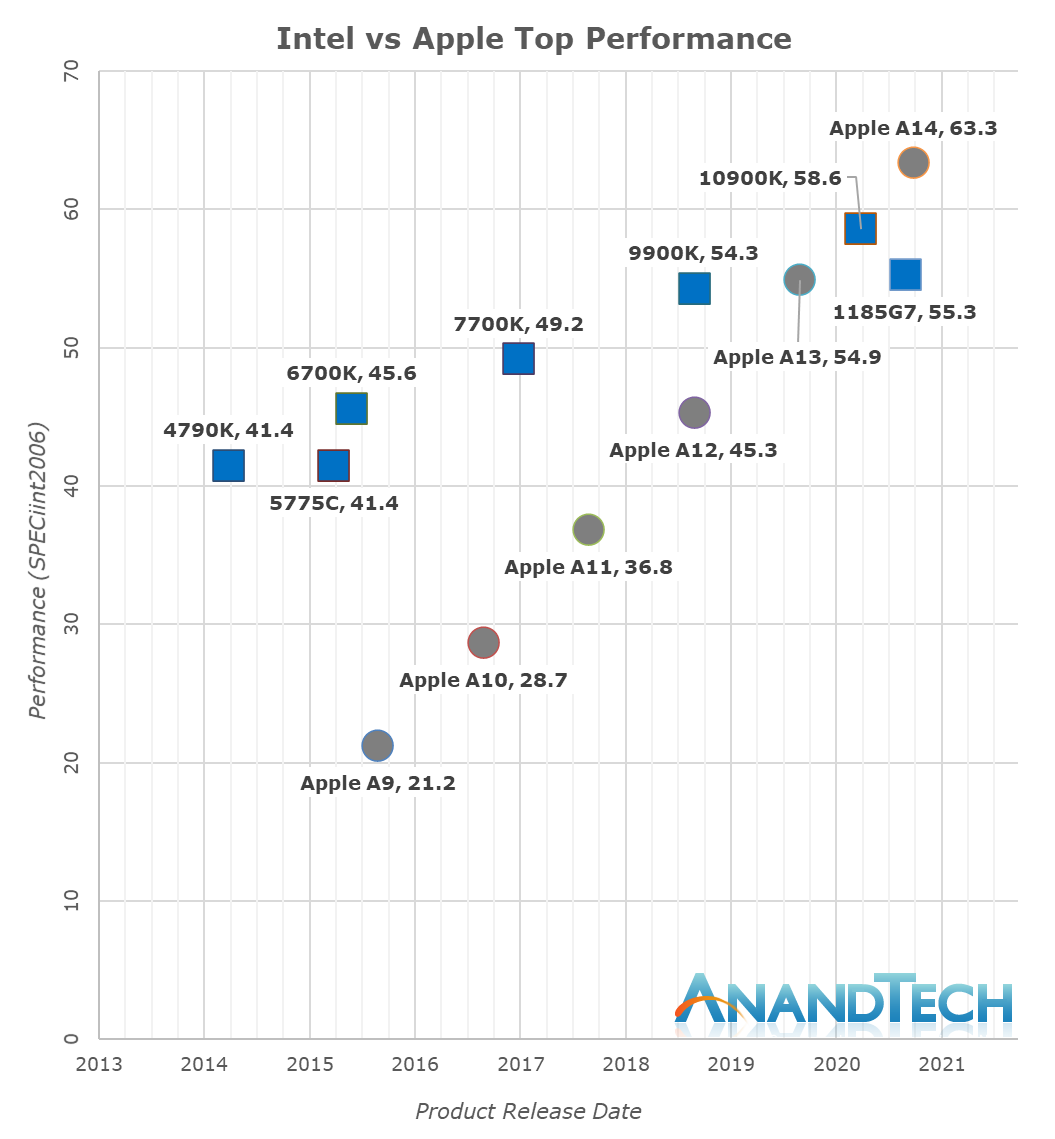
Apple's decision to ditch Intel and be in charge of their own destiny has done wonders in the short term but there will surely be consequences in the long run. Apple Silicon can't stay ahead forever and will hit a plateau. It's inevitable. At that point, they don't have the option to call Intel or AMD again. What are they going to do then?
They'll hire people from AMD, Intel, or whoever else happens to be around then. Money talks, and Apple has a ton of it throw at the problem. Their marketcap is larger than AMD, Intel, TSMC, and NVidia... combined.
It's not like making their own cpus and switching back to intel/amd are the only options anyway.
It seems more likely that other arm processors will catch up to intel/amd, and in that case they won't need to necessarily always make their own processors as long as they can just get another company to add support for any custom instructions they use.
> Apple Silicon can't stay ahead forever and will hit a plateau. It's inevitable.
Yes.
> At that point, they don't have the option to call Intel or AMD again. What are they going to do then?
I think there will be plenty of vendors, including Intel and AMD, willing to sell to Apple, actually.
They also have other potential alternatives - Apple is also rumored to be doing lots of R&D into RISC-V and other architectures that don't require licensing ARM.
> Apple is also rumored to be doing lots of R&D into RISC-V and other architectures that don't require licensing ARM.
Out of all the companies making CPUs, Apple seems the least likely to have problems licensing ARM. Apple co-founded ARM, and they seem to have much more favorable licensing terms than any other company, likely due to some old contract from the Newton days that's been grandfathered in.
The Asahi project is discovering quite a few ways in which Apple's processors break the ARM spec and/or implement custom instructions -- which not even architectural-license holders are allowed to do. See e.g. this comment thread from a few days ago: https://news.ycombinator.com/item?id=29783549
There was nothing unreasonable or problematic about Apple creating their own chips. It was good strategy and good business. It's good for the industry and end users. Everyone wins except for Intel, but Intel will gladly sell them chips again if they get the chance. It's money.
Not at the moment. But there’s nothing fundamentally preventing Apple from writing an ARM to x86 translator. It’s probably easier that the opposite direction because x86 provides stricter execution ordering guarantees than ARM.
That's just not how business works - if you're in any kind of b2b business and the CEO of a $3Tn company calls you, you take the call and you bend over backwards to win the business if you can. If Tim Cook called Intel and said Apple was thinking about going back to Intel, Intel would surge like crazy to make it happen. The same exact thing would be the case for AMD or anyone else for that matter.
Intel's strategy is often to hire the best talent of their competitors. Case in point Jim Kelly from AMD who did a stint at Intel after the success of Zen.
This guy was not the head of the M1 processor initiative from my readings, but he was involved in it.
I think I got this from the HN mythology, but it was a story about a consultant who was just one in a long string of consultants that all said the same thing.
Intel strikes me as a company that basically needs a chorus of folks to sing to them, "change your tune, you know what to dooooo"
Whatever beef Jim had, they should probably just fix that. Intel is just a really fancy machine shop with a small design firm on the side that has the blue prints for something that lots of people want. Until they don't.
Open your fabs, open your engineering services and you will be the largest force in semiconductors. Hell, even if Intel's designs were 100% open source, they could still smoke.
That is actually Apple's strategy. They always set up sites around their competitors, San Diego (QCOM), Orlando (AMD), Austin (lots), Portland (Intel).
Intel on the other hand really couldn't care less about talent. Their Portland site has been around for decades and Intel has knowingly underpaid the engineers there the entire time, because it was a one-company town ever since Tektronix became irrelevant. Intel is all about hiring C and D-hitters at discount rates so managers can build an empire of loyal slaves with no options.


Anecdotally, lots of Intel engineers have also been leaving due to frustration of getting things done and pretty poor compensation compared to the rest of the industry.