I did my PhD at a top US institution in the 00s, and post-doc in the late 00s, working on somewhat related stuff.
Working with synthetic mRNA was hard during my time. I would imagine that it was many times more difficult in the 90's. Just as an EE analogy, working on mRNA in the 90s is like working on extreme UV lithography in the 80s. It was too far into the future to be useful, and there were better research funding opportunities for other things. But if one was smart, one could see the potential. It's not so surprising that she got passed for tenure, working on something so crazy wild. It was around 2005-2010 time frame when mRNA synthesis became affordable enough to become an applied science rather than basic research.
It sounds like Kariko lost her associate professor position in the 90s, but continued her work as a postdoc for more than 10 years. That's some awesome dedication to something that almost nobody thought would work out. It's not so surprising she jumped ship around 2010 when the mRNA tech caught up.
>I hope she gets her Nobel prize. She deserves it.
If she and the others involved in identifying the root cause and coming up with the vaccine, do not get the Nobel in Medicine/Chemistry i will consider the whole "Nobel Prize" system to be a complete tool and sham.
Woah woah woah. Just take a breath and recognize that the "Nobel prize in Chemistry/Physics/Whatever" is soon 110% completely different from them "Nobel Peace Prize". It is a shame they share 2 common words.
"Hakuin used to tell his pupils about an old woman who had a teashop, praising her understanding of Zen. The pupils refused to believe what he told them and would go to the teashop to find out for themselves.
Whenever the woman saw them coming she could tell at once whether they had come for tea or to look into her grasp of Zen. In the former case, she would server them graciously. In the latter, she would beckon to the pupils to come behind her screen. The instant they obeyed, she would strike them with a fire-poker.
Nine out of ten of them could not escape her beating."
If a big part of the nominations is obviously politically motivated, should the others get the tea or the poker?
If you put a rotten egg by accident into an 20 egg omlett, it is still spoiled.
If you dilute a brand name with controversial actions or products, it drags the whole brand down. And it does not matter of parts of it are still good.
"For 108 years, the Norwegian Nobel Committee has sought to stimulate precisely that international policy and those attitudes for which Obama is now the world’s leading spokesman. The Committee endorses Obama’s appeal that 'Now is the time for all of us to take our share of responsibility for a global response to global challenges.'
And two really good books, and a really good documentary film, and eight years in high political office pushing for action that aimed to saved millions of people now doomed to be displaced from climate change in the next decades. Awarding it to Obama for not being GW Bush is one thing, awarding it to Gore something entirely different.
That said, AFAIK Obama himself found it somewhat cringeworthy when he was awarded the price, which - if it is true - makes it a lot less embarrassing on his part.
Also it seems they really haven't had reason to be happy with a couple of other candidates too, one leading a country that massacred Rohingas under her leadership and one starting another war in Africa.
Reading this, it struck me that we're quite fortunate that COVID-19 hit in 2020, and not in say 2000, when there would have been much less hope for development of a quick and effective vaccine.
The rate from infection to mortality has increased notably. Our government is trying their best to paper over the seriousness. Just now people on social media are demanding a harsh lockdown like March because its getting out of hand. Maybe news outlets will cover something I can link to.
and has recently got approval. I can't help but wonder if they'd offered it generally with a not fully tested warning when it was offered to "employees of some large state-run companies" presumably in April/May, how many lives would have been saved.
Well, both Russian and Oxford vaccines seem very effective, even though they are using conventional technologies. Without BioNTech or Moderna, an effective vaccine would have been delayed by maybe 3-6 months, which isn't too bad.
But now that mRNA vaccines have been proven, they might be mass distributed in about 9 months in a future pandemic.
an effective vaccine would have been delayed by maybe 3-6 months, which isn't too bad.
You realize such a delay would mean many more people would die not to mention the overall damage to society from lockdowns? I can’t understand how that would possibly be not “too bad.”
Sorry, my "not too bad" comment was based on the initial estimate for the vaccine, which was 18-24 months from the start of the pandemic. That would have been July or Dec 2021.
Science really came through this time. We not only had a new vaccine platform that arrived just in time (mRNA), but our conventional vaccine development was also able to get a good vaccine out much sooner than scientists originally thought.
Epidemiologists existed in 2000 and were quite capable of recognizing the difference between a global pandemic and "a really bad flu season".
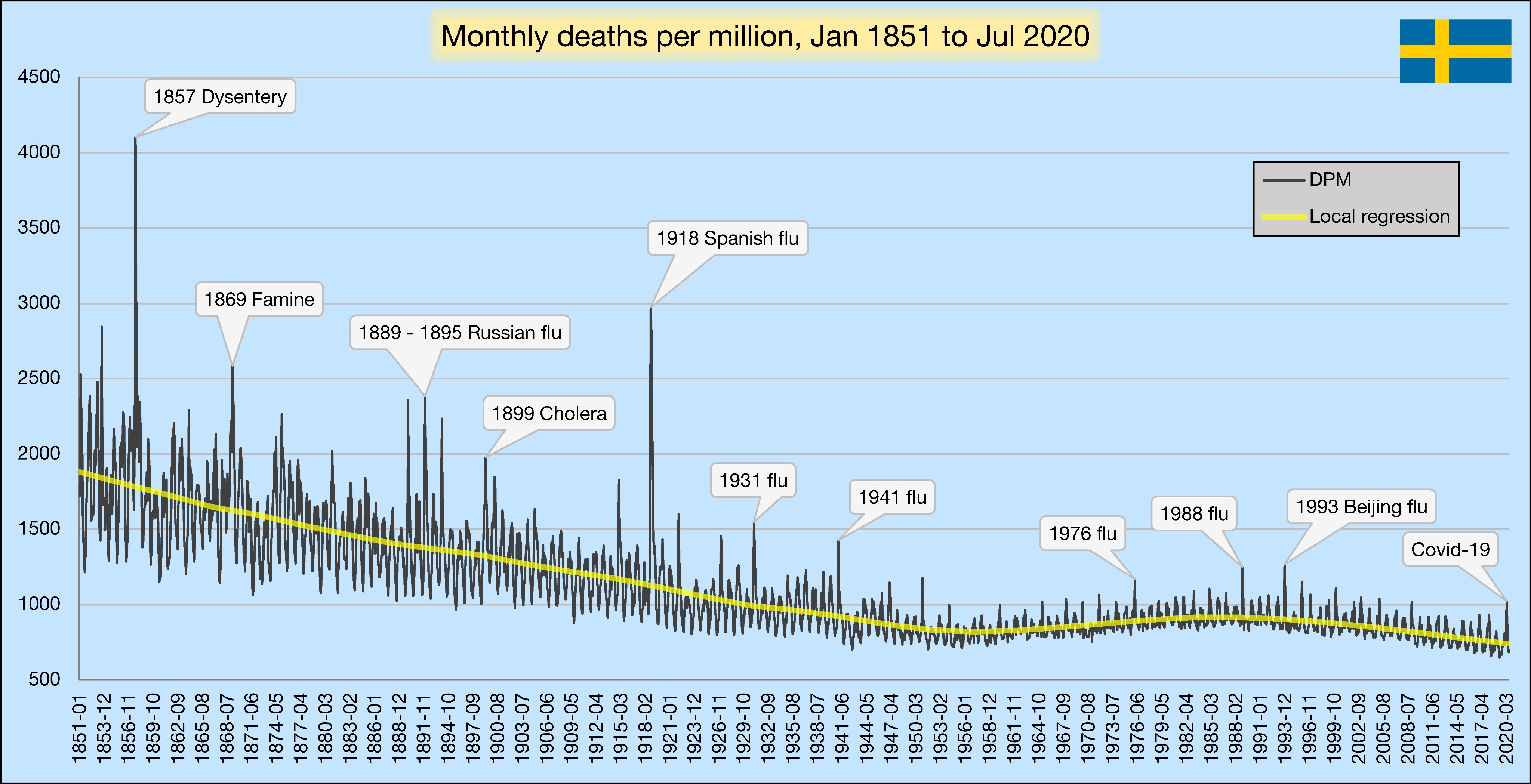
Hell, the 1918 pandemic literally was flu, unlike COVID, and it predated a lot of what we think of as modern medicine, and it was heavily censored by governments around the world, and it was still obvious that it was more than just "bad flu season."
Those who compare COVID to a really bad flu season don't seem to understand just how bad a bad flu season can get. The estimated deaths from 1918 are thought to be 17-100x what COVID has caused so far.
For some people, maybe. For others, it's merely recognizing and stating that we've gotten through bad or even worse epidemics than this. Often without the sensationalized hoopla. Eg,1968.
I'd argue it's the people saying it isn't comparable to a bad flu season who are the ones less familiar with the flu's devistating history.
The fact that we've gotten through worse doesn't mean it's not a major issue. There's a large gap between "human civilization will survive this" and "not a big deal."
When was the last time 350,000 Americans died in a 'really bad Flu season", even without lockdowns? When was the last time deaths per day were measured in the thousands?
If you don't trust me perhaps you'll listen to Donald Trump, who told Bob Woodward in early February 2020: "And so that's a very tricky one. That's a very delicate one. It's also more deadly than even your strenuous flus.... This is more deadly,” he said. “This is five per — you know, this is 5 percent versus 1 percent and less than 1 percent, you know. So, this is deadly stuff.”
And don't forget scientists have continued to gather and evaluate data since. We now have a much clearer (albeit still imperfect) picture of the disease and its behaviour.
For example, COVID's current "death rate" estimate is ~3x worse than flu. Versus Trump's "~5x" in your quote from Feb 2020¹.
People love to argue about such overall rates but for practical purposes, they're too crude a hammer – too aggregate, too high-level to be actionable. More importantly, we now have a better understanding of the groups at risk.
> [Infection fatality rate] measuring 0.002% at age 10 and 0.01% at 25. However, the rate progressively increased with age, growing from 0.4% at 55 to around 15% at 85.
Age and certain comorbidities seem critical. This knowledge shapes the global COVID response, allowing help to be significantly more targeted and effective. For instance, when rolling out national vaccination plans.
___
¹ Whichever rate Trump was talking about – there's case fatality rate, crude fatality rate, infection fatality rate…
Oh sure, that was just a best estimate at the time, bottom line is we and he knew it was going to be bad from the start and that his public "just a flu" statements were false.
Yet still we have people to this day repeating his knowingly and now admittedly false claims as though they are true. That's how deep the hook line and sinker got swallowed. It's fascinating psychology. Even when the con artist admits and explains the con, some people prefer to stay conned.
> For example, COVID's current "death rate" estimate is ~3x worse than flu. Versus Trump's "~5x" in your quote from Feb 2020¹.
COVID-19 Infection Fatality Rate is estimated at around 0.6% whereas H1N1/09 Flu infection fatality rate was estimated to be less than 0.03%. Not sure where you get “3x”, I think the correct number would be 20x based on these numbers.
I compared Covid's estimated IFR of < 0.23% to flu's < 0.07% [1].
But that's exactly the discussion I called out as not terribly relevant: The variance within Covid (due to age, location, comorbidities…) is much greater than variance between Covid and flu.
In other words, even a Covid-vs-flu rate difference of 20x (as you say) is dwarfed by the 1000x difference between Covid age groups (which you didn't contest). Can we agree on that?
My point is that a broadly aggregated statistics like "global IFR" is too crude to be actionable. Easy to put in a headline, sure, but more potential for confusion than good.
Disagree strongly. An IFR of 0.6% when considered across the entire population is indeed cause for much more alarm than one of 0.02%. It is very relevant.
0.6% of the population in the USA, for instance, would mean about 2 million people would be killed by uncontrolled and massive COVID-19 spread.
Focusing down to small subgroups would only be relevant if you have a magic wand and could, for instance, seal off all over-60 year olds from human society for a year.
P.S. the paper you cited is by John Ioannidis. He has become notorious in 2020 attempting to prove Covid-19 isn’t very dangerous. Worth consideration as this version has managed to pass peer review, but keep in mind it’s outside the mainstream of opinion. IMO, the 0.2% estimate is pretty clearly low and I’ve read a good debunking of that specific paper in the past. https://threadreaderapp.com/thread/1316511734115385344.html
I'll put it bluntly: fixating on an average ("average IFR") of a wildly heavy-tailed distribution (e.g. exponential for IFR-vs-age) is idiotic.
Technically yes, such average exists – the population is finite. But taking a population-wide decision based on such estimate is suboptimal. We already know a population parameter (age, comorbidities) that gets us an actionable segregation!
I personally see such "hiding behind an average of an exponential" as scientific fraud. Misinformed at best; disingenuous and murderous at worst (such as with Covid).
> He has become notorious in 2020
Interesting, thanks. I wasn't aware of John Ioannidis' pedigree. For those curious – this article does a good job summarizing the controversy (April 2020):
> Focusing down to small subgroups would only be relevant if you have a magic wand and could, for instance, seal off all over-60 year olds from human society for a year.
A magic wand to seal off over-60 olds? How do you feel about sealing off everyone?
> A magic wand to seal off over-60 olds? How do you feel about sealing off everyone?
Worked great in New Zealand and Taiwan, and pretty dang good in Singapore, Australia, and even China. A pity we weren’t fast enough to do it here.
I haven’t seen any society successfully execute a strategy to exclude the aged from human society or viral transmission yet, and we’ve had 9 months to experiment. If such a strategy existed and was proven to work, your theory that it was idiotic to ignore it would make sense. Unfortunately, it doesn’t seem to exist.
Suicides and homicides also up. Given that these deaths will occur for people with a typical age of 40, vs 80 for COVID, substantially more years of life have been lost from lockdown (which seems to have achieved little anyway), than from COVID.
And the last year with record overdose deaths was: 2019. And with the exception of 2018 every other year backwards from 2017 to 1999 was also a record drug overdose death year.
That is the opioid crisis.
Source: The CDC WONDER database, group by year, and by "UCD - Drug/Alcohol Induced Case". (Deep link doesn't work)
The US is a flaming pit of despair right now, for reasons stretching far beyond any impact COVID-19 may or may not have had. It's not reasonable to take the state of specifically that society as any sort of benchmark for how bad things are.


Working with synthetic mRNA was hard during my time. I would imagine that it was many times more difficult in the 90's. Just as an EE analogy, working on mRNA in the 90s is like working on extreme UV lithography in the 80s. It was too far into the future to be useful, and there were better research funding opportunities for other things. But if one was smart, one could see the potential. It's not so surprising that she got passed for tenure, working on something so crazy wild. It was around 2005-2010 time frame when mRNA synthesis became affordable enough to become an applied science rather than basic research.
It sounds like Kariko lost her associate professor position in the 90s, but continued her work as a postdoc for more than 10 years. That's some awesome dedication to something that almost nobody thought would work out. It's not so surprising she jumped ship around 2010 when the mRNA tech caught up.
I hope she gets her Nobel prize. She deserves it.