The fellow with the round glasses is and a moustache, is physics professor Kristian Birkeland. While working on an electric cannon he had invented, he came up with a theory that could explain the northern lights (stella borealis). The photographer himself and professor Birkeland went on expeditions together in the arctic parts of norway. Few believed in Birkeland’s theories, until modern satelites proved he was actually right and it’s electromagnetic.
To me it seems like some of the young women liked the photographer. Some of my ancestors lived in Oslo at that time, and could be present in some of the photos. As an inhabitant of Oslo myself, these photos are a real gem.
The photographer would wear the 6-inch diameter chrome camera under his vest. The lens would poke out a buttonhole, and the shutter could be tripped by pulling a cord. The camera could shoot six images on a circular dry plate; the photographer would advance the plate by patting his chest to activate a lever. [...] The camera, which retailed at $15, was popular among amateurs and professionals alike.
I didn't realize exposure times of film were short enough to get snapshots like this in the 1880's.
Disc shaped and all metal in construction, at first glance the camera resembles a cross between a frisbee and a hip flask. Thin enough to be worn unobtrusively beneath an ordinary waistcoat, it hung from the photographer’s neck on a strap. The f10, fixed-aperture lens poked through a buttonhole of the waistcoat and, as a further aid to concealment, was designed to look like a button.
Exposures were made on a circular glass plate that was rotated after each exposure by turning a knob protruding from the front of the camera. Six photographs, 40mm in diameter, could be taken on each plate. Rotating the knob also set the rotary shutter, which was released by pulling on a length of string which dangled from the bottom the camera.
Two research breakthrus in the 1870s paid off by the 1880s
The first was cooking the gelatin emulsions makes the grain much larger but much more light sensitive.
The second (minor) one was adding small amounts of dyes to emulsions make them sensitive to colors other than blue, so B/W looks more realistic and also is obviously more sensitive.
"I didn't realize exposure times of film were short enough to get snapshots like this in the 1880's."
Neither did I. If fact my immediate reaction was "bullshit". I honestly thought this was fake until I saw your comment. Thanks for doing the legwork/verification.
Kinda odd that in 2018, these types of buttonhole cameras aren't super easy to find. I mean they have them on spy gear websites, and we all have phones, and there was Google Glass, but nothing super cool that's an obvious choice.
The Narrative Clip is similar - the Clip 2 sells for about $200, which isn't too far off from the adjusted price. It's not branded as a spy camera, but looks pretty discreet.
A 640x480 VGA camera for Arduino, where the lens is about 1cm, so it'd fit pretty well, is about $5. Throw in a Nano for the board for another $5, and an SD card module for another $5, and you can probably build your own for about $20 all up.
Prebuilt, I've seen a few wireless "drone" cameras of similar quality for $20, and a few Chinese shops carry cameras like this [0] for $25 or so.
But... If you want better than a crappy VGA, you'll be looking for a while.
I just figured out why I think these photos are so interesting. I thought about these photos all day and couldn’t stop wondering why.
I don’t think I’ve ever seen such an old photo of people that weren’t posing. I feel like these photos are a magical window into life back then. It’s so amazing and eerie at the same time. Look at them tip their hats to greet the man. Look at these people walking down the street, petting their cats, and enjoying life. But yet they are all gone and don’t know how the world changed. Amazing.
Look at how clean those streets are! Is there someone from Oslo who can comment on these streets now? Are they still as clean (because they're in the political district?) or did we make our cities more dirty since then?
Oslo is a very clean city, but it also feels a lot busier now than it looks in these pictures.
A lot of the photos were taken around the parliament buildings, the royal palace, and the national theatre, which may explain why the streets are so clean and the standard of attire is so high.
Our streets look similar to this, I rarely see any litter unless after a really big event or similar.
Background:
I'm not in Oslo but I'm living in Gothenburg which is both close by (roughly 3 hours with bus) and roughly the same size. I live on the main Avenue (avenyn) walk to and from work so I see much of the central inner city every day.
If you like blurry old candid photos of people about town, you might be interested in the work of Miroslav Tichý, who from the '60s to the '80s made his own cameras, that were so rubbish they didn't look real, so people didn't behave as if they were being photographed [1]:
I was thinking the same. I wonder if he knew them or they are strangers. I grew up in a village and if you saw someone, even if you didn't know them (although you knew most people), you'd say hello, but it's strange to imagine that happening in a city today.
Looking at the pictures it seems that they were taken exactly in the moment of greeting the photographer (People with their hands on hats...). The way the function of the camera is described, using the gestures of greeting someone may have nicely helped in keeping his camera a secret.
Also: Indeed, very nice to see people smiling in that time! I wonder how much the grim-looking portraits we know add to the cliche of hard-ship and sadness we have of earlier times.
Then, having to look that way when being portrayed may stemmed from who were the earliest people being portrayed: Saints, Kings and Queens.
Then, having to look that way when being portrayed may stemmed from who were the earliest people being portrayed: Saints, Kings and Queens.
That certainly might have contributed to the lack of smiling, yes. From sources I have long since lost, it is my understanding that portraits were expensive, and photographs were serious business. Add to that the fact of...umm, why do we smile for photographs again? I do it because everyone else does. Build a time machine, and someone from the 1800s is going to ask, "why does everyone in your photographs look like a smiling idiot? Was there a rash of some brain-eating disease in your time?" I've also heard the theory based on exposure times, but by the very late 1800s exposure times had dropped dramatically. Though it could be argued that not smiling was a carry-over from the days of long exposure. Again, though, documentation I've seen simply said, "that's just how it was done".
Fashions change, just like we don't wear corsets anymore (well, I don't; but I don't judge), now we smile for pictures.
> I've also heard the theory based on exposure times, but by the very late 1800s exposure times had dropped dramatically. Though it could be argued that not smiling was a carry-over from the days of long exposure. Again, though, documentation I've seen simply said, "that's just how it was done".
Presumably photographic portraits were done in the style of painted portraits.
Hmm, so maybe it is a result of "exposure time". Dunno about you, but I sure can't keep a smile on my face for a few hours while Leonardo does me in oil. (Err, wait, that didn't come out right...)
Despite any documentation, I think it's just a matter of asking for an answer to a negative action. "Why didn't you smile for your photographs back then?"
"Same reason we didn't do a handstand: why would we?"
> it's strange to imagine that happening in a city today
Sometimes I fantasize about just greeting everybody I come across to add some friendliness to the world, until I realize that most people, in an urban setting, would probably be utterly bewildered and confused by such a behavior.
It's sad how urban living seems to have conditioned us to treat every other human as a total stranger from whom we should keep the furthest possible distance, physically and emotionally.
In old days, smiling in a photograph would be considered ridiculous. There would be nothing worse than having one’s image forever captured with a goofy toothy looking grin.
It's not just the lack of smiling. It's that they were stiff as a board, staring expressionlessly out into space, looking lifeless, taxidermic.
The candidness of these photos is interesting because the people look so natural. It's not just the smiling, it's the casual, natural looking poses and expressions, only about half of which are actually smiling. They look actual real life people so to speak.
It was because photos required long exposure and it's easier to hold your face in a neutral position. People smiled then as they do now: https://imgur.com/gallery/EYOym
Wait, this is wildly off topic, but can we talk about the snow woman in the sixth picture? What is happening there? Is that a person covered in snow? A really shockingly well crafted sculpture done by two women with shovels? I am so baffled.
Scanned PDF has almost 300 MB, but its text description says:
The accompanying picture shows what can be done with snow, by those who care to exercise their powers of modelling, and produce something more natural in appearance than the familiar old " Snow Man," built up
after the figure of a Lowther Arcade Noah. During a lull in the severe frosts of last winter, two ladies (amateurs, who had never had a lesson in modelling), with the assistance of only a shovel and pair of scissors, erected and modelled the " Snow Lady" in a garden near Pangbourne. No foundation of any kind was used, and no sticks or wires were concealed under the figure for the purpose of supporting head, body, or arms. An enlargement of the original photograph was shown at the Photographic Exhibition during last autumn, and gave rise to many remarks, sage and otherwise. A large number of those who looked at it pronounced it as " No doubt very cleverly got up — but all humbug ! " " Real snow ? Not a bit of it ! Quite impossible ! "
And elegant. I’ve always assumed people were overdressed for the picture, and here I notice they actually wore the hat everyday. They dress better than for today’s weddings.
There are 33 photos from him at https://imgur.com/a/Eplvs. Several look as though the subject is aware of the camera, and at least a couple don't look pleased about it.
Thank you for this. All the smart-ass comments on the other site linked was really starting to ruin this for me. There's this wonderful beauty on display here and the response on the boredpanda site is low effort stupid jokes? Come on.
It is in public. And if you sneakily take a photo of someone, how would they know to react? On top of that, there are cameras everywhere in public taking covert photos of everyone, I haven't seen anyone react to it.
They're portraits, not wide angle crowd shots (and yes, the law distinguishes between the two, for privacy and copyright purposes). And the people reacting are the ones you told that you were taking sneaky photos, not the subjects of the photos (although if they did pick it, they also might not be pleased - FTFA: "This is physics professor Kristian Birkeland - the only one of Størmer's subjects to rumble him. Apparently he got quite cross!").
Try taking a bunch of covert photos then showing your friends: "Hey look at these photos I took of people with my spy cam!" I guarantee the reaction won't be entirely positive.
I always marvel at both the differences and the similarities between pictures like these and today. I hope someone over at https://www.reddit.com/r/ColorizedHistory/ takes a crack at some of these.
Whenever I see pictures from the pre-WW1-era I marvel at the shoes people wore back then. From the outside they appear comfortable, sturdy, and elegant. I wonder which would be more comfortable to wear -- hand-made, customized shoes from a 1900's-inspired, experienced shoemaker, or modern, mass-produced sneakers (which are pretty comfortable to begin with).
Yes, and the clothes. Okay, I know by many statistical measures we're wealthier now. But those clothes would cost a fortune now. Do they have fewer outfits? Are we only seeing the elite?
My grandfather was a tailor, and ended up employing a 100 people or so. Tailor made clothing was the norm, rather than the exception for anybody of moderate means and just about everybody that could afford it had a sewing machine or knew how to use one. Sewing machines were common wedding gifts, and were the equivalent in money of a small car today. Fabrics were of far better quality than the ones we have today and repairing stuff rather than throwing it away was normal. Fashion was as much a thing back then as it is now.
I grew up in a house that still has a sewing machine. My grandmother knew how to use it, and my father does too - he still repairs some old pieces from time to time, but never touches anything made of newer fabrics, he says there is nothing that he can mend there. Funny thing, he's a civil engineer.
> Fabrics were of far better quality than the ones we have today
At a low confidence, I'd suggest that fabrics were often of higher quality, but even more often were simply sturdier. Our "better fabrics" often have a focus on being light weight at a cost to durability - which is a fine thing for some use cases and a poor fit for others.
They almost certainly only had one or two outfits for going out. The ones strolling around might also be richer on average as the poorer would need to be working (either at a job or in the home).
EDIT: I suppose the photographer might have preferred better dressed subjects, too.
We dress worse now than we did than because clothing is cheap and mass produced. If you look at a typical middle class family from 1880, much more of their paycheck would go towards clothing, and they would have far fewer options in what to wear.
I wonder about that myself. Those are some elaborate outfits. Manufacturing the full outfit with first world labour by hand using natural fibres would cost 1000s of dollars in today's market.
One guy had a beaver pelt top hat. I read somewhere that at one time they cost as much as a Porsche in today's dollars, though you can only make a crude analogy between our money and theirs.
On average, sneakers will always win. Making shoes by hand is hard.
On excellence, it's really about taste and task. A comfortable leather shoe is heavenly, but you still wouldn't run in it. They will smell less though.
This said, pre-WWI shoes were already mass-manufactured for the most part. Mechanization arrived in mid-19th century.
I have a pair of old-style hand made shoes from McKinlays https://mckinlays.co.nz/ - they are super comfortable (following a couple weeks of break in) and quite sturdy. McKinalys seems to mainly sell off-the-shelf shoes (as mine are), but they also do custom work.
I recently bought a good pair of hiking boots - Lowa Renegade mids, to be precise - and as well as being supremely sturdy and looking pretty smart, they are the most comfortable things i have ever worn on my feet. They sort of grip my feet tightly enough to feel really snug, but not so tightly that they pinch. They'll probably be too hot in the summer, but until then, i'll be wearing them all the time.
Same here. Must have a good leather sole as well. Finding that is hard. But I had a pair of shoes from a Spanish (Spain) brand whos name escapes me - but best shoes I have ever had. I had them re-soled twice as I loved them so much.
Also, watching vids of bespoke shoemaking is satisfying
I'm the exact opposite. I often work at a standing desk and I can last a lot longer standing in sneakers than leather shoes.
The big reason though is that I'd much rather have 4 pairs of $100 sneakers than one pair of $400 leather shoes. I get bored of wearing the same shoes and being able to frequently swap them out for new ones is part of the appeal.
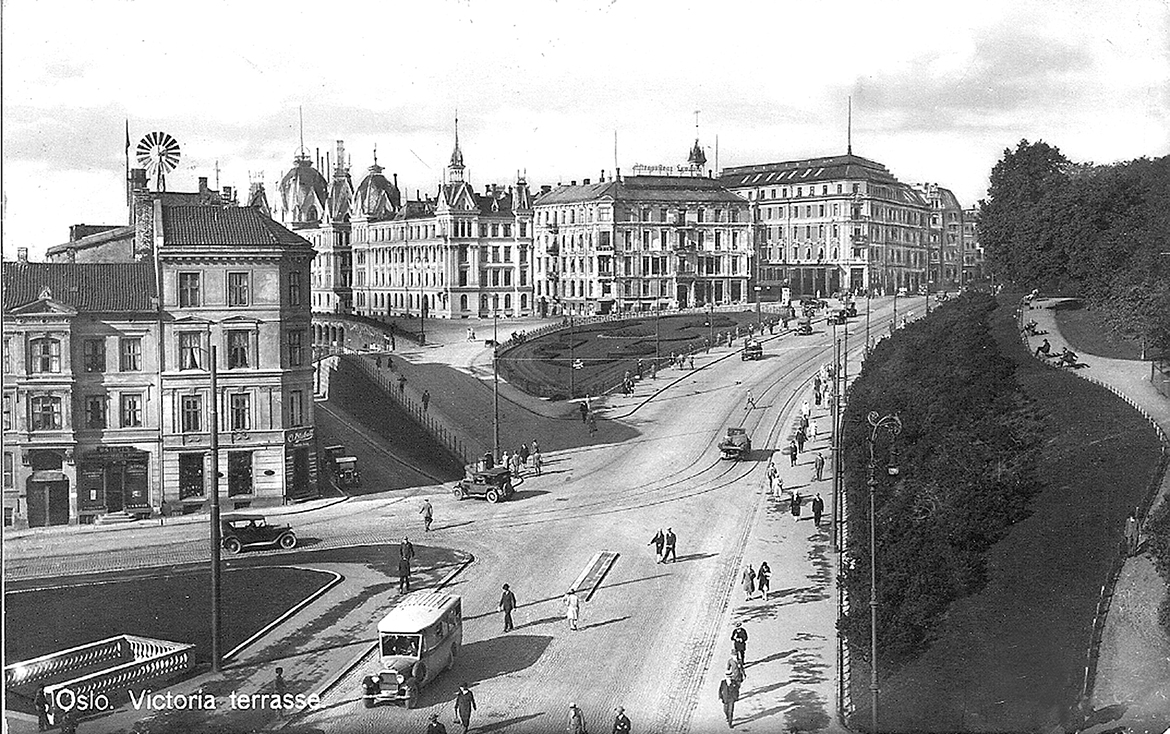
What/where is the location of the (third) picture with two ladies and a very curvy street? That looks like an optical illusion of sort given his POV, or is the street really as curvy and as steep as that? Beautiful shot that one.
It doesn't seem particularly stretched by a "fish-eye" effect, all vertical lines of the buildings remain vertical, it is just a particular effect of the perspective, compare with:
I walk by this street corner every now and then, and was puzzled by this as well. It's quite different today, but the location is more or less on top of the National Theater railway station [1]. I think you are right about the lens making it look more curvy/steep, in this aerial photo from 1937 [2], you can tell it's just 180 degrees.
For the Bay Area contingent, a similar series of candid photographs taken by Walker Evans in the 1940s - 60s is one of the current MOMA exhibitions if you're looking for an excuse
They are elegant because they are probably from the local bourgeoisie. Go out of the city center and I would bet clothes would look way worse than that. It was probably a minority who could afford to dress like that.
Nice pictures. But... what happened to using img size tags? The page is very hostile to the viewer since if you start browsing the pictures, it keeps adding photo elements as they load, making it impossible to actually read anything or view the photos until all the images have loaded. Seems to happen a lot to me these days.
edit: I should note, the article now links to a better-behaved site.
People generally caring about declaring img size attributes died out like 15 years ago. grumble
Declaring image sizes doesn't fit into the distributed model that is that is the rage these days, so I guess people don't care since it's so hard. At least it makes their ms/req numbers look great, nevermind that the experience for the actual users sucks.
Partly in rebellion to the grungy apparel of my co-workers at a Linux company, I started wearing suspenders and a tie most of the time in the early 2000s. Still wore a tie off and on until about 7 years ago, but working from home really killed that for me.
Now I have several dozen ties I love and never, ever wear them. A shame, really.
I find them very uncomfortable, ugly, and overpriced. I would be very happy if suits would rot in the dustbins of history. I guess everyone has different tastes.
I sort of want to start but don't want to deal with the explaining. My buddy started with the nice leather briefcase and he got relentlessly roasted in college.
I've worn a suit almost every day for the past 3 years, no one really mentions it. Looks perfectly casual depending on the tie and jacket you pick. Natural materials for ties somehow look less formal I've found.
Clicked the article thinking maybe a Norwegian Google Streetview competitor had invented time travel... Was still worth the read! Was not disappointed.
I visited this page two times and it caused my browser to download a file called 'n5hm6dsspmjfor3d5akscs.gz' and then another called 'rblsat02tsnsr899bpjig2.gz'.
Same - When I visited the site I got a load of application download requests - seems like it has been compromised unless its some corrupted image lazy loader?
OP here - apologies all, looks like this should have been the BoredPanda url in retrospect. Funny enough, I thought BoredPanda was a social click farm by the name and when I went to MyModernMet I had no issues.



To me it seems like some of the young women liked the photographer. Some of my ancestors lived in Oslo at that time, and could be present in some of the photos. As an inhabitant of Oslo myself, these photos are a real gem.