I don't see any indication that the chatter contains information related to solving the puzzle rather than, say, simply expressing their emotional state. There are plenty of animals which mutter to themselves while thinking --- humans included!
The obvious experiment here is to have two groups of dolphins positioned so that they can hear each other but not see each other; give one the puzzle, and then, later, give the other the same puzzle. If the second group solves it consistently faster than the first one then probably information is being transferred. (Although it could just be that the second group is more motivated after hearing the first group get excited about something.)
Actually arranging an ethical but meaningful experiment with bottlenose dolphins, which are quite big and are highly opinionated, is left as an exercise for the reader...
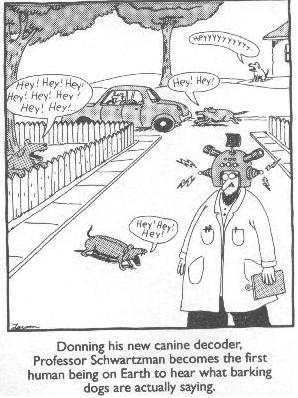
The evidence that they are using a complex "language" is definitely weak. For example, how does it prove that they aren't simply saying, "Hey, hey!" to each other like the Far Side cartoon[0]? I would have preferred more interpretation of the different noises the dolphins make over the fact that they are making them in the first place.
They same way we are almost certain that the Voynich manuscript contains an undeciphered written language, by applying a combination of information theory, computational linguistics, and statistics.
> If the second group solves it consistently faster than the first one
They can also transmit cooperation information non-verbally, by posture for example, so your experiment testing for speed would test two things, possibly cancelling each other. It's possible that the verbal communication exists but lowers the efficiency of the cooperation (maybe one of them is yelling at the other how stupid he is and that they should use his superior technique).
> During the trials when one dolphin opened the canister unaided, one or more of the other dolphins was present nearby, watching the task. On these occasions, there was no increase in chatter.
Thanks. What always gets lost in these articles is the difference between communication and language, which has a precise difference that most people are unaware of.
Ah, but Rupert Sheldrake observed this effect with rats running through a maze significantly faster after a previous group of rats did it before without any communication whatsoever. He tested it with humans and puzzles as well. You also have to account for the morphogenetic resonance.
I'm not trolling. Perhaps you mean to say that his theory is difficult to falsify or even non-falsifiable. I disagree with that, it predicts a specific outcome under certain conditions. His experiments show results, these experiments are difficult to reproduce, that doesn't mean there isn't some unknown mechanism at work and it's just methodological error as you assert. So if you are going to do this dolphin experiment and you have to account for this hypothetical mechanism I'd do the experiment at the same time overlooked by the same scientist (skeptic or believer doesn't matter in the psi hypothesis).
Also read:
http://www.scientificamerican.com/article/ruperts-resonance/
I don't know how sound that data was, but in one of the cases the rats were solving a maze on the other side of the world (Australia) ... and yet started solving it better than the first rats in the UK. I'm not sure what the conclusion or the methodological error is. But it's not as simple as you paint it.
  - They gave a puzzle to 24 couples of dolphins.
  - In order to solve it they had to cooperate.
  - Out of those 24 dolphins only 1 couple made it.
  - This couple was making more noises than the rest.
Conclusion: Dolphins were brainstorming on how to solve the puzzle.
> - Out of those 24 dolphins only 1 couple made it.
No, they gave the puzzle 24 times to 6 pairs of dolphins. One pair got it each time, although 4 times a single dolphin from the pair managed to get it own its own.
I would really like to read the paper. Did they get better in time? Did the one dolphin figured it out on its own before or after he figured it out with his pal? Why was he even able to pull it off on its own anyway?
LOL It's not even that :) I reread it again and it is so confusing! It looks like they repeated the puzzle 24 times in a swimming pool with 6 dolphins, only 2 dolphins ever managed to solve it once
"The team conducted 24 canister trials, during which all six dolphins were present. Only two of the dolphins ever managed to crack the puzzle and get to the food."
I think we'd learn more about dolphin communication by generating tasks that require a human and dolphin to collaborate in the water; the task should be novel for both subjects.
As things are we seldom let the dolphin 'lead' the task; but these animals are highly adapted to the water. With a human-dolphin pair, the dolphin would be in the position of using its superior knowledge of the environment (sonar) to direct the human's superior ability to manipulate objects (hands). For example, how would a human-dolphin pair collaborate in a pitch-black cave?
Dogs are very good at manipulating human behavior; the party line is that wolves have better problem solving in general but dogs are better when there's a human in the room. Dolphins don't have the benefit of coevolution that dogs do, but they're smart and social; I bet they could figure us out.
I remember seeing a video about chimpanzees collaborating to untie ropes. What surprised me wasn't the team problem solving, it's the speed and impliciteness. Each just poked at one side of the problem, got stuck, the got closer, somehow agreed on something then synchronized their actions so the rope would open the food gate.
Interesting. Some, including the developmental psychologist Michael Tomasello[0], who's written extensively on first language acquisition, would say that the ability to share attention is central to human language.
When those human skin bags give us these puzzles, they seem to make unintelligible noises, albeit slowly.. Perhaps we can figure out how to talk to them if we can stop doing simple puzzles only to show that we have working minds and languages. /dolphin (to other dolphin)
I wonder how dolphins and other animals would react to a VR headset and virtual hands? With an interface tailored to actions we could gauge their language capabilities without the need to understand the sounds. I wonder what dolphin VR CoD would look like.
I don't know anything about animal (verbal) language. But I'm curious if there are any animals whose apparent language is advanced enough that zoologists may believe that the animals have a conceptual language similar to ours.
If so, I wonder if ML algorithms have ever been applied to decode the languages? I suppose collecting the data may be hard, but it feels like ML may better suited to predict/decode the language than qualitative observations by humans? e.g. what if communication happened more via power than frequency?
Sadly, we've never found anything that proves animal communications have grammar. Or in information-theoretic terms, these are low entropy messages. They are instinctive things, like a hard-wired set of warning cries, or "write-once", like how male songbirds learn their species song during puberty, and will produce it identically forever, once stabilized (even if they go deaf!)
Unfortunately, Dr. Slobodchikoff, while indeed having a PhD, is not actually a linguist, and most of his papers are in other fields. Here's a pretty good assessment of his prairie dog claims: https://badlinguistics.wordpress.com/2011/01/06/hold-the-fro...
I wonder if this could be used to decode dolphin language. Have the dolphins separate and make the puzzle require communicating about images on a screen or something. The other dolphin would have to push the correct button to get the prize. Recording all of these interactions could be used for machine translation maybe.
"Scientific American wants permission to send you notifications". Came on a bit strong there guys, at least let me browse a couple of pages and tell me what the notifications might be...



The obvious experiment here is to have two groups of dolphins positioned so that they can hear each other but not see each other; give one the puzzle, and then, later, give the other the same puzzle. If the second group solves it consistently faster than the first one then probably information is being transferred. (Although it could just be that the second group is more motivated after hearing the first group get excited about something.)
Actually arranging an ethical but meaningful experiment with bottlenose dolphins, which are quite big and are highly opinionated, is left as an exercise for the reader...