Without any disrespect to the author, why don't we all just start thinking for ourselves when it comes to our health, rather than being told contradictory information every 3 years by mainstream media?
One minute it's best to eat ice cream for breakfast; the next minute we shouldn't eat any carbs at all; then we should start drinking red wine every day; then more water; then less water, etc. It's as if we're just a big experiment or some sort of inside joke to the mainstream media.
How do we "think for ourselves"? Come up with independant reasoning?
Lots of things are highly non-obvious. Vitamins weren't discovered until the 20th century. Many baby's lives are improved by their mothers taking folic acid. I would never guess how few calories there are in things like raspberries or strawberries without having been told about it.
Certainly there is lots of terrible health advice, and it's a major issue, telling people to "only read good advice" seems like the worst advice I've ever heard -- obviously we would all only read the good advice if we knew what that was!
I think most of it is actually obvious. Healthy foods: vegetables, fruits, fish, non processed meat. Unhealthy foods: candy, soda, deserts, alcohol, lots of butter, ... .
The biggest issue for most people is not that they don't know the difference between healthy and unhealthy foods. The problem is to eat the healty foods and stay away from the unhealty ones, which is quite a challenge.
I somewhat disagree. It may be "obvious" to well-informed HN readers. However, I don't think food nutrition is obvious to a significant portion of the population. Proof of this is how the food industry advertises and labels their products to take advantage of buyers' ignorance:
-- orange juice with labels saying that it's "fortified with extra vitamins and calcium". (Many people will associate oj with positive connotations of "fruit", and the vitamin supplement is a bonus. Result: unsophisticated buyers think of oj as "healthy" when it's really concentrated sugar water that will contribute to obesity and tooth decay.)
-- lean cuisine "low-fat" microwave dinners with a "heart healthy" icon on the box. (Naive buyers see the "low fat" as a signal for "healthy" but don't realize that manufacturers have to amplify the taste by adding lots of salt. The heavy carbs in those meals are also controversial.)
-- granola bars and "energy" bars. (The packaging has pictures of active hikers, bicycle riders, mountain climbers, etc. Some granola bars even prominently feature "fiber" as a benefit. The ignorant don't realize that these snacks are really glorified "candy bars" with clever marketing to lessen the guilt trip of eating a stick of sugar.)
-- fat free yogurt. (They took out the fat but now the yogurt has lots of sugar, which is another form of calories, which most people won't burn off, which then gets stored as fat anyway.)
-- photographs of celebrities with milk mustaches shown on billboards and magazine ads and associated slogans like "milk does a body good!". (Those ads are promoted by the dairy industry and it's questionable whether it's healthy for adults to drink milk.)
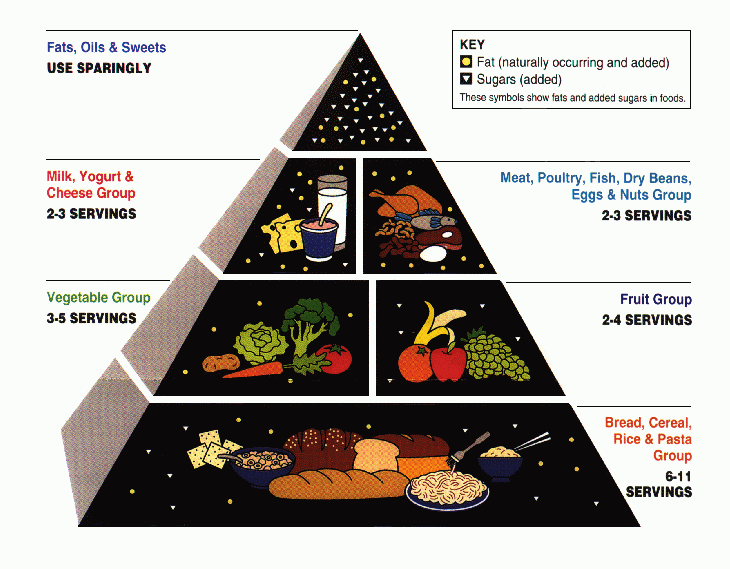
-- USDA food pyramid. (The uneducated don't realize that the USDA (and hence the chart) is influenced and manipulated by the meat & dairy industries. Because the nutrition advice is officially published by the government and plastered all over school walls, it feels authoritative. Naive consumers don't realize that if the food pyramid was designed by nutritionists not financially linked to meat & dairy, they would place vegetables as highest priority.)
For the consumers that get exposed to nutrition information in a passive way, they really don't know the difference between healthy and unhealthy foods. There's so much misinformation and manipulation that the American consumer is less knowledgeable about what's healthy than the African bushmen eating wild berries and hunting antelope.
> -- USDA food pyramid. (The uneducated don't realize that the USDA (and hence the chart) is influenced and manipulated by the meat & dairy industries. Because the nutrition advice is officially published by the government and plastered all over school walls, it feels authoritative. Naive consumers don't realize that if the food pyramid was designed by nutritionists not financially linked to meat & dairy, they would place vegetables as highest priority.)
Huh? Neither of the food pyramid[0] or its replacement[1] have meat and dairy as highest priority.
Edit: The pyramid that came in between[3] does have milk at a similar size to vegetables, is this the one you take issue with?
> photographs of celebrities with milk mustaches shown on billboards and magazine ads and associated slogans like "milk does a body good!". (Those ads are promoted by the dairy industry and it's questionable whether it's healthy for adults to drink milk.)
I'm approximately 81% sure that such marketing is targeted at children and/or their parents.
> granola bars and "energy" bars. (The packaging has pictures of active hikers, bicycle riders, mountain climbers, etc. Some granola bars even prominently feature "fiber" as a benefit. The ignorant don't realize that these snacks are really glorified "candy bars" with clever marketing to lessen the guilt trip of eating a stick of sugar.)
This isn't universally true; there are quite a few brands (like Premier Protein) that specifically advertise low sugar and fat content.
> USDA food pyramid. (The uneducated don't realize that the USDA (and hence the chart) is influenced and manipulated by the meat & dairy industries.
And yet still prioritizes grains, fruits, and vegetables well before meat and dairy (at least until 2005, but my brain still refuses to comprehend the new "MyPyramid" as the One True Food Pyramid, seeing as it completely misses the fucking point of a food pyramid, but whatever). Not that it really matters that much, seeing as how the USDA has (as of 2011) migrated over to the whole "MyPlate" concept, which emphasizes "proteins" instead of meat specifically (and while it does emphasize dairy - with the implication that said dairy is meant to come from a glass of milk - I'd argue that the target audience has generally been children, not adults).
> lean cuisine "low-fat" microwave dinners with a "heart healthy" icon on the box. (Naive buyers see the "low fat" as a signal for "healthy" but don't realize that manufacturers have to amplify the taste by adding lots of salt. The heavy carbs in those meals are also controversial.)
Plenty of "diet" microwave dinners, including those from Lean Cuisine, prominently display low-carb advertising claims. Of course, they tend to swing back to high-fat, but so do most decisions involving the balance of carbohydrates, lipids, and protein.
The paleo diet doesn't include products based on milk, so it would surprise me if they think butter is healthy.
But it doesn't matter, because you can find all kinds of studies that alcohol, chocolate, etc. is healthy. Amount of salt, eggs etc... those are basically all up for discussion. What I'm saying is that for the most part of your diet, it's pretty obvious what's healthy or not.
Alcohol is a diuretic (unlike coffee apparently). So in the context of the discussion about water, yes alcohol is unhealthy in that it causes dehydration.
If there are health benefits to alcohol (and there may well be), I'm sure that adding rum to your coke won't suddenly make the drink healthy.
Don't be so quick to label all butter as unhealthy. Butter from pasture-fed dairy cows is a great source of fat-soluble vitamins, particularly vitamin K. The commodity butter you are likely to get from mainstream brands is not. As it is an animal product, what you get out of it depends a lot on what you put into it, and there is good reason why most livestock-based companies do not want to make an issue of their husbandry practices.
There is even some evidence that indicates that not only is pasture-fed butter better than trough-fed butter, but that regularly rotating the herd to a different pasture every N days is even better. But when the press talks about butter, all butter is the same.
And let's not get started on alcohol... I believe that the current story is that somewhat less than one normalized drink per day is now healthy, and that it does not even have to be red wine.
Do your vegetables have too much oxalic acid, biological contaminants, or residual farming chemicals? Is your fish farmed, or wild-caught (using slave labor)? Is this meat processed just a little bit, or so much that it is now unhealthy? Is this "pink slime" stuff okay, or not? Is this tomato bred for flavor and nutrition, or for uniformity, ease of processing, and visual appeal?
So it's not obvious. It is, in some cases, intentionally obfuscated, to protect business interests.
Most people do have a vague idea of what is healthy, and what is not. But they have no clue when it comes to subspecies, sources, processing, transport, preservation, and preparation.
I know that spinach is a supposedly healthy food. But I have no idea whether there is any significant difference between canned spinach, block-frozen spinach, or bagged fresh spinach. I don't know on an instinctual level whether it is better to sautee it in butter or to bake it in a pastry with feta cheese. I'm not sure where it comes from, or if it is a different variety than spinach grown from seed. Sure, the unhealthiest serving of spinach is probably going to be better than the healthiest serving of gummi bears, but I don't typically eat just one thing when I eat. That spinach might come with a sandwich attached to it, or salad dressing, or barbecued pork, or feta and phyllo.
So it's not always spinach versus gummi bears. Sometimes it's gyros with spanakopita versus pulled pork sandwich with side of greens. I literally have no idea which of those two lunches is healthier, or even if the same lunch plate from different restaurants will have a similar healthiness profile.
The only way I could possibly keep track would be to have a digital assistant that is able to automatically evaluate everything I might put in my mouth and give a recommendation for a healthier alternative that isn't so far from whatever it is that I want to eat that I will ignore it. If I want a burrito from Taco Bell, I might need a recommendation for a burrito from Los Cocineros Hermanos, rather than the good karma salad from Hippietown Vegan Lunchery.
What you're saying is undoubtedly true but I think the commenter was also trying to state "what's right for some people isn't right for everybody" that is, every body is different.
Are we all experts who are capable of thinking for ourselves ("thinking for ourselves" seems to equal: inspecting the primary literature, or review literature, and coming to a conclusion)? No, we're not.
Thinking for yourself is untenable- we need scientists who are experts in analyzing data to provide specific suggestions, and disseminate those in the media. Unfortunately, there is little consequence to reporting false conclusions, or inaccurate health data, so I don't see any change forthcoming.
Out of curiosity, do you realize that the same thing can be said about religion? You don't know enough about it - definitely not as much as the people who specialize in it - so you should listen to your priest on the subject. Or politics: just pick a party and follow its lead, politics is a complex subject and you can't know as much as the professionals.
I would say that nutrition falls somewhere between religion - where the facts are all made up - and, say, math or physics where we're pretty damn sure the scientists aren't making all the facts up. But it definitely leans towards the scientific side where real facts can be known and people who devoted decades of their life to it have a tangible advantage over the layman when evaluating claims about it.
I respect a theological scholar or priest's mastery of their religion in the same was as I would respect an ardent nerd's mastery of Tolkein's universe, which is to say it is real respect for studying at length a somewhat internally consistent system of mythology. But no matter how much more that nerd knows about mythology I wouldn't trust his word about how Middle Earth actually existed at some point in the earth's history.
As for politics...well that's a huge can of worms isn't it? I would mention that it's not a politician's job to know about politics, but it's their job to get elected and accrue power. A better analogy for you to make might have been political scientist, in which case I would indeed trust their judgement over my own gut feel when it comes to questions about politics like why so-and-so won the election.
Protestants, at least, have the idea of the "priesthood of all believers", meaning roughly that each person can have authority in doctrinal matters. So you should listen to your priest, but you don't have to accept that he's correct if God is telling you something different. Thus the billion different protestant denominations.
Protestants if you go back to their roots actually expected you to become an expert in scripture in order to recognize when your "priest" is wrong. But they didn't promote anything goes. It's more that you should learn and be able to apply scripture correctly. This didn't prevent the proliferation of denominations because of course different people would interpret a piece of scripture differently and get really worked up about it.
This is in contrast with Catholicism, where pretty much everything was conducted in Latin rather than local languages; the emphasis on layperson understanding of theology was a direct response to the trend of most followers having zero understanding or ability to understand the scriptures and sermons they were expected to follow.
Of course, this also resulted in the more decentralized power structure relative to Catholicism's. Quite a bit of Protestant philosophy and tendency stems from immediate responses to a perceived-to-be corrupt and exclusive Catholic Church.
It definitely is so. What authority do I have to talk about economics or law? Shouldn't I leave that to the people who do know what they are talking about?
Kind of a central problem in democracy, if you think about it.
Publishing misleading health studies wouldn't be so risk-free if your average American could easily distinguish a legitimate expert opinion from a media/commercial one.
Unfortunately most Americans don't have access to a quality health education necessary to make that distinction.
I disagree. We have ample evidence that legitimate experts came to the wrong conclusion (for example, studies of the relationship of cholesterol to heart health).
What we need to systematic meta-studies that are analyzed and published by geniuses (see the Cochrane Collaboration).
It might hurt to read that because it pinches on the untouchable tenets, I mean, who dares to admit not being a individual free-thinker?
However, if you look behind the "smokes, you'll see he has a point. I proudly admit that I wouldn't think for myself on situations such as choosing a complex therapy. I know nothing about it; what would I do? Trust the Internet?
Well the research has shown [too lazy to come up with a citation for that] that it is very beneficial for patients to be well informed and involved in the therapy process - with healthcare professional as an equal partner, not as a "god" in the matters of health. It's called "patient empowerment" and it's a big thing since 1994. And one of the best ways to inform the patient is a decision aid (which is ranging from fliers to IT systems with semantic webs with auto-updating medical evidence sources). This works, because you don't have to an expert on athletes' foot to manage your diabetes well, you just have to be an "expert" of your own case. And that, my friend, is the definition of individual free-thinker.
> Well the research has shown [too lazy to come up with a citation for that] that it is very beneficial for patients to be well informed and involved in the therapy process
That's an irrelevant point: You won't see me advocating against having the patients fully informed and making decisions, after being given "alternatives" and respective pros&cons by their physicians. But what I was discussing was the knee-jerk reaction to the "thinking for yourself is untenable" argument.
> This works, because you don't have to an expert on athletes' foot to manage your diabetes well, you just have to be an "expert" of your own case.
I would say it's very oblivious to think you're an expert on your case. It means your emotions are way too much present: the fact that something is terribly relevant to you doesn't imply that you're an "expert" in it.
> And that, my friend, is the definition of individual free-thinker.
Quite a strange definition. But OK: if that's a very important point for you to make, great.
Just don't say that this is "thinking by yourself". You may have made the decision yourself, but the "thinking" part was on the physician all the time. He had the knowledge, he presented it to you, alongside the pros&cons, and he was there to warn you if you by chance made a wrong/worst decision.
There's a strong push to get patients to be more involved in their own care and to make decisions about their health and to be experts in their own health condition.
Patient choice is (in the UK) written into law and into Department of Health, and NHS, and Clinical Commisioning Groups, and Trust guidance documentation.
You might want to learn what people mean when they talk about expert patients because it's not going away and you seem to have some misunderstanding about it.
> Just don't say that this is "thinking by yourself". You may have made the decision yourself, but the "thinking" part was on the physician all the time. He had the knowledge, he presented it to you, alongside the pros&cons, and he was there to warn you if you by chance made a wrong/worst decision.
This assumes that doctors are not subject to the same cognitive biases that patients are. But doctors clearly are subject to those same biases. The RCT for knee arthroscopy shows us that.
I think your reply is generally misguided and straw man-like fallacious. I never advocated against having patients involved and making decisions (which I pointed explicitly above), nor said anything which justified you prompting me with something like "Patient choice is (in the UK) written into law" (where have I questioned that?). It seems you're replying to someone else, probably a straw man.
> This assumes that doctors are not subject to the same cognitive biases that patients are.
I really can't tell how could you reach such conclusion. I just said that the doctors are the ones which hold and present the knowledge, as well as supervise your decision. No mentions. at all, to "patients are biased; doctors are 100% objective".
Again, what I was discussing was the knee-jerk reaction to the "thinking for yourself is untenable" argument.
>I would say it's very oblivious to think you're an expert on your case. It means your emotions are way too much present: the fact that something is terribly relevant to you doesn't imply that you're an "expert" in it.
I wouldn't discount emotions as being irrelevant for health. Patient involvement is very important in the empowerment process, and the patient is the expert in the ways that physician can never be: [s]he, not the physician, knows that drug A causes his/her skin itch; he, not the physician, cares for the quality of life, etc. And, sadly, you miss the point completely: experts have broad knowledge of the situation, while the "expert" patient knows (with the help of experts, of course, of course, of course) his exact case. And the "thinking" part is not done by physician all the time. Empowered patient does the majority of "thinking", the physician is there for support and information. Physician is the expert systems' knowledge base, while the empowered patient is the expert system doing the "thinking" and making informed/educated decisions.
>Unlike the traditional approach, empowerment is not something one does to patients. Rather, empowerment begins when HCPs acknowledge that patient are in control of their daily diabetes care.
>Empowerment occurs when the HCPs goal is to increase the capacity of patients to think critically and make autonomous, informed decisions. Empowerment also occurs when patients are actually making autonomous, informed decisions about their diabetes self-management.
And this is not a new thing in heathcare either, there is a plethora of articles saying the same since 1994.
Quoting out of context like that it sure seems pretty absurd. But I'm going to trust you understood GP's point?
Any sane person wouldn't presume to thing for themselves on the best course of action in treating their cancer, for instance. The same thing goes for nutrition and health.
As the GP you're referring to: I'm a PhD scientist with deep knowledge in biology. I still wouldn't try to decide for myself on how to treat my own cancer; I can use my knowledge to evaluate what the experts tell me, but there are limits that even a knowledgeable scientist is susceptible to.
Many people think otherwise: they second guess medical experts using their own engineering or scientific knowledge. Sometimes this "seems to work" but it's not clear that it does so in anything but an anecdotal way. Carefully controlled trials and meta-studies are much more effective.
At the end of the day, the average not-athlete person who just wants to stay healthy should just remember that magic word: "moderation". Everything is good as long as you don't have too much of it, and for the basic necessities (water), just follow what your body tells you instead of ignoring/suppressing it. You won't get fat because you've had 7 glasses of water rather than $MAGIC_NUMBER$, so there is no point in obsessing about these.
If you are an athlete, of course, things are different; but in that case you should probably talk to professionals, not blindly trust mainstream magazines.
I mostly agree with this point of view, with the small caveat that what constitutes moderate is not always obvious - I remember coming to the US for the first time and being in awe as to how large portions were, for example.
Just like there's no "healthy" amount of carbonated soda either, but having an occasional glass of coke won't have any result on your health whatsoever. That's also moderation.
There's definitely a negative effect on your health from one glass of coke. Small, but still an effect.
For starters you're exceeding the recommended daily intake of added sugar with one can of coke. No big deal, but if your liver could talk, it wouldn't be happy. Your blood pressure rises, again no big deal, but still not good.
There was an article a few months ago, I think on HN, with a headline to the effect of "Scientists link <some chemical> to <some mental health issue>". Clicking through a few links to get to a more authoritative source, and it sounded more like "Our results show a correlation with a larger uncertainty than we'd like to see, and this contradicts a similar study done previously". People need to understand the statistical nature of these studies and what conclusions that should be drawing. IMO an understanding of correlation vs. causation, factors, levels and control groups, etc. should be part of any decent education (i.e. well before college). We can't expect mainstream media to help of it's own accord.
This complaint of "Why can't these scientists make up their minds?" is addressed well in the book "The China Study" ("Forks Over Knives" was the movie sequel to this book).
Before you are two conflicting research papers. One says eggs are bad, the other that they are good. One paper came from The American Poultry Society, and the other from The Poultry Research Institute (those are made up names for the sake of argument). One of those organizations is full of industry shills, and the other is actually doing legitimate research. Every few years, they release papers which contradict the another, in an endless arms race.
The problem which the consumer is faced with is: which is which?
I should mention that a modern antidote to this are the efforts of people like Dr. Rhonda Patrick (http://www.foundmyfitness.com/), who is on a mission to read research papers and distill them into digestible form for the public. Her appearances on the Joe Rogan podcast are all excellent (also available on youtube).
The problem is that ad-based revenue has an incentive to:
1) Publish whenever there is a single study.
2) Be overly dramatic in either direction.
What we need is for a Bayesian-oriented medical doctor to spend a bunch of time keeping up to date on the literature, especially meta-analysis of multiple randomized controlled trials and then give that information to us with appropriate context. Luckily, this exists:
The problem here is your reliance on mainstream media for this kind of information.
It's a sad state of affairs, I know, but you simply cannot trust mainstream media for this. If a compound that - per chance - exists in beer is discovered to influence lipolysis in vitro , then mainstream media will tell you to drink a beer to get lean. And it's not only mainstream media fault; universities and research centres PR departments will probably report it in the same way, under the disguise of "making it friendly to the average Joe".
This doesn't mean, however, that you should strictly "think for yourself". Of course, you're not supposed to follow everything blindly, but if you're not an health expert (or even if you are!), It's better to trust authoritative sources and your physicians.
> but you simply cannot trust mainstream media for this.
Can you trust them for any real information? In my eyes mainstream media is there to tell stories. Oftentimes bedtime stories for sheepwalkers.
But the truth (TM) - well whatever that may be, I do not see it in media. At least not very often.
Regarding the "trust your physician"-part:
I would even take their advice with a very big grain of salt. At least looking at my own experience and the experiences of my significant other in this regard. (And I know, anecdotes not evidence.)
> Regarding the "trust your physician"-part: I would even take their advice with a very big grain of salt. At least looking at my own experience and the experiences of my significant other in this regard. (And I know, anecdotes not evidence.)
Thing is... "which" grain of salt? Physicians fail frequently, but what's the alternative? I wouldn't know what to question, and on which basis. I could read about it on the web, but why would I trust a strangers report instead of a flawed, but at least "certified", physician?
Well you could try to, step by step, experiment with different diets and regularly have a look at your fitness-level, your blood work, your weight, the composition of your body (%of water/fat/and so on).
Before that you could read a lot. Some studies, some literature. A lot will be on the strange to the bullshit-level. But the self-experimenting part will teach you, what is good for your body and what not.
For example one of the problems we face in this field seems to me, that we do know so little about the bacteria (and so on), we have in our intestines. There is quite an active field of research and a lot is happening there. Maybe some day we will know more, coming from this part of science.
Untill then, living with a significant other who had to listen to her body for 15+ years, I for example learned, that reducing my intake of carbohydrates (and esp. sugar and wheat) helps a lot in reducing my weight, while the reduction of fat does not help that much (Every time closely watching my caloric intake).
But I would not recommend doing exactly this to everybody - it is something, that subjectively, anecdotally works for me.
> Well you could try to, step by step, experiment with different diets and regularly have a look at your fitness-level, your blood work, your weight, the composition of your body (%of water/fat/and so on).
A diet is a complex set of variables. I could look at it holistically, ignore individual variables, and try to make sense of it as whole but a) there's more to health than body composition (such as %BF); and b) I wouldn't like to assume that I can read a blood work panel and interpret it as a physician.
It's not that I don't do this: I work-out daily, I weight and measure myself daily and I also track everything I eat. However:
a) I won't stop getting checked out by competent professionals, so I still put my main trust in physicians; and
b) I can't assume that my "diet experiments" are innocuous. Our bodies, as systems, are way more complex than the systems we engineer. We can't really predict the interactions between all the variables we experiment with (and are subject to). What if I seem OK by now with my diet choices, looking at what you mentioned + my subjective well-being, but end up developing something bad in the medium/long-term? Then I won't be happy with my experimentation. :)
> Before that you could read a lot. Some studies, some literature. A lot will be on the strange to the bullshit-level. But the self-experimenting part will teach you, what is good for your body and what not.
I also do that, quite a lot. I also took a few MOOCs. But I wouldn't say I fully understand what I read, or assume I can interpret a paper in health sciences. It's research-level material, meant to be read by people from the field. I have a PhD in other scientific area: I wouldn't expect someone from other field to make full sense out of a article in my field, so why would I assume I could?
> But I would not recommend doing exactly this to everybody - it is something, that subjectively, anecdotally works for me.
My point is, although I can fully relate (because, well, that's what I do), I'm not able to say "it works for me". It seems to be working, but if I'm scientifically unable to say "it works" without some degree of certainty in my field, why would I do so in a field in which I'm ignorant?
Alternative is the idea of "empowered patient": a well-informed patient which has a healthcare professional as a partner instead of an ultimate "expert" authority figure. There's a lot of scientific articles on that idea, and it seems to be working pretty well.
Anytime you have your "trust switch" permanently set to "on" or "off" for any given source of info then I would classify you, using your term, as a "sheepwalker". Just do your best to always employ critical thinking skills, platitudes such as "never trust mainstream media" will just land you in another trap.
You can just remove "mainstream" from that post. It's of course fine to defer to experts on matters you know nothing about, but you really shouldn't let other people do your thinking for you at all, ever.
It's not a joke to the media, but fundamentally their job is to report new things. Not to take a view on the things, or check them for truthiness or flawed methodology -- just to report them.
(Your choice of media will determine how much extra value in terms of checking, discrimination etc is added to the news you see reported)
But they like telling you to forget what you know and take on board $newfact because it is easy copy (scientists say so!) and it gets pageviews/sells papers.
I think we should stop overthinking food. I think this is one of the single biggest problem we have regarding our health.
I'd argue that as long as someone has no eating disorder (lucky you), eat whatever you want whenever you want and I'm pretty sure you'll be fine.
The problem is rather that almost everyone seems to have some kind of eating disorder. If you can't stop eating or hate to eat (because of time, because of your self image or whatever), that's a different problem then the question what's healthy and what not. Eating healthy won't fix the eating disorder. But thinking too much about what you are suppose to eat, when you are suppose to eat and how much makes it arguably much more likely to develop a eating disorder.
Because a lot of this stuff is hard to figure out with a sample size of one?
In the case of water, I don't know of anybody who has ever advocated drinking very small amounts of water; the dispute is over how much is enough. It's just a tricky bar to set. Not because we disagree on the benefits of good hydration, but because daily water needs are extremely variable and the color of your urine is about the only practical way to measure hydration.
It's also both simple & valuable to hydrate. At least for me, nothing has made a bigger difference in my condition.
It does look like that the near future will have more individualized health advice rather than generic one-line suggestions regarding nutritions and diets. The problem looks from my personal point of view that we are lacking measuring tools which can help identify what status the body is in and how it reacts to changes, and from there having the medical expertise to understand the whole picture.
Mainstream media? Sure, I agree. But listening to reports on actual science, I disagree.
Saying that people should "start thinking for themselves" is disingenuous I believe. For one, this is how we get shit like faith healing, homeopathy, healing crystals and so on. "Normal" people don't have the resources to test a hypothesis, nor the time in most cases. Say you have cancer. What's better? Thinking for yourself and eating a naked mole rat every day for dinner because "they don't get cancer"? Or read some reports and research that apply to your case, and go to a doctor armed with some extra information that will help you both make an informed decision about a treatment?
The problem lies entirely at the feet of the media. Lack of scientific training and a desire to create interesting, attention-grabbing headlines makes for situations exactly what you're complaining about. But this is no reason to eschew science. Science is doing what it does: conducting studies that only test for the smallest amount of variables as possible. It'll be a long time before science will be able to perfectly say "a human of type foo must live exactly like this to achieve maximum potential in life". This is a huge ever-changing puzzle, and while we might have the edges built (my grandma taught me you always put the edges together first) we don't even have all the pieces out of the box. Science finds a piece with a tiny flower on it and the media happily exclaims the puzzle is a picture of a garden.
"The problem lies entirely at the feet of the media."
No, not entirely. You assume scientists are objective and have no agenda. A lot of research is "sponsored" by corporate interests. The first paragraph one should read in a research report is the "source of funding" disclosure, then adjust for bias (or ignore entirely).
Scientists are also incentivized by the publishing system to find noteworthy results, which often leads to finding evidence where there is none, especially in fields like nutrition where the signal to noise ratio is so low
Or just as common but perhaps more misleading: results in isolation. Even with solid protocols and methods plenty studies, say with rat models, have a very limited factor they are testing, and identifying if there is an impact compared to a control. Unfortunately the baseline model parameters might have a huge impact on any difference observed. Like say diet prior to the study. Or genetics other than what was modified for the study. Or any number of similar things. Changing a single variable in a complex, non-linear, non-closed system with doesn't necessarily generalize to other conditions. So even good studies can mislead until they've been replicated and many variants attempted and some underlying mechanism identified.
Very true, and in fact I had "almost entirely" there for a brief moment. Although I'd like to offer the counter-argument that journalists should be listing known agendas and funding sources that may create biases when reporting on these stories. That's their job. I know it's an idealist pipe-dream, but to me a journalist's highest calling is reporting on corruption and corporate shenanigans exactly like that.
So yes, this is more of a shared problem, but the media has let us down here, too.
"journalist's highest calling is reporting on corruption and corporate shenanigans"
I agree, but that ship has sailed a while ago :-(
Traditional, corrupt and/or click-baity journalism is slowly being replaced by guerilla news sites (such as Drudge, ZeroHedge, etc.), but I am not aware community-driven scientific paper review sites (i have not been looking much, though)
> Thinking for yourself and eating a naked mole rat every day for dinner because "they don't get cancer"?
I bet naked mole rats taste great. I wouldn't hold it against anyone.
That said, the problem runs even deeper than what you indicate: "mainstream media" (and even not-so-mainstream media) also tends toward things like faith healing and magic crystals and "a $GEOLOCATION_RESULT mom discovered this one stupid trick and doctors HATE her!" because humans are enamored by the extraordinary and tend to give extraordinary things undue attention. It's rare to find a news organization that doesn't fall victim to this for the simple reason that they are run by humans who - more often than not - have difficulty identifying and addressing such biases, and in turn inadvertently pass them on to their readers and viewers.
This is the same reason why Peter Popoff - despite having been uncovered as a fraud decades ago - is still in business, getting paid programming on the Discovery Channel while selling "Chernobyl water" that's probably from some tap in Odessa, TX. Humans crave the extraordinary, and when they don't, they crave wealth.
Didn't 'studies' proclaim the benefits of polyunsaturated fats like margarine over butter in the 70s and 80s and then go and reverse position recently?
Considering the amount of 'bad' science about (poor quality studies or those with an agenda) I think there's a lot to be said for common sense. Good quality food, as close to its natural form as possible, eat it in moderation and exercise accordingly.
We shouldn't think for ourselves about our health (I wouldn't prescribe myself medicine, after all), nor should we listen to what mainstream media has to say. I thought it was common knowledge that for people actually interested in staying healthy the best thing to do is ignore the fads publicized on media.
Just listen to your doctor, or research medical papers yourself.
The idea that you shouldn't eat any carbs is put out there by quacks like Peter Attia. There is plenty of evidence to suggest a plant-based diet high in carbohydrate is the best for health.
Health aside, some people report cutting carbs entirely or almost entirely helps them lose weight. As for whether it's "healthy", who really knows, but it appears to be statistically significant when it comes to weight.
A simple explanation for this: cutting carbs is tricky and requires a lot of careful planning etc., increasing the likelihood that people actually stay under their maintenance caloric intake. It doesn't really matter how you do it. As long as your expenditure is larger than your intake, you'll lose weight.
In any case, your point doesn't say anything about the healthiness of carbohydrates.
In any case, your point doesn't say anything about the healthiness of carbohydrates.
There's evidence (sorry, I don't have the citations in front of me) to link carbohydrate intake to increased triglycerides, higher HDL, and more inflamation - pretty much the opposite of "healthy". OTOH, there's reason to think that a low carb, high fat, moderate protein diet may improve lipid profiles, and reduce the risk of heart disease.
Now, I can't say with certainty that a low carb, high fat, moderate protein diet is better (or worse) than a high carb, low fat diet, or a high protein diet, etc. And I think part of the problem is simply that when you talk about human health and the connection between health and diet, there are just too many variables, and it's hard to control for them all. Hence the fact that you can find research endorsing a number of different diets, which appear diametrically opposed to each other.
A high fat diet increases HDL. If a person is overweight their HDL may drop if they experience weight loss, but it will not drop as much as someone who is on a plant-based diet. About 75% of the people who die from coronary artery disease have what is considered optimal cholesterol. Your cholesterol has to be much lower than what is considered optimal to lower your risk.
"On July 21, 1990, The Lancet published the findings of Dean Ornish, M.D., who demonstrated that heart disease can actually be reversed without medicines.13 Until then, most doctors were not even attempting to reverse heart disease, even though it was, as it is now, the most common cause of death. Most believed that the plaques of cholesterol and other substances that clog the arteries to the heart would not go away. The traditional way to remove them was to wait until they became severe enough to warrant a bypass or angioplasty.
At the University of California in San Francisco, Dr. Ornish tested the theory that a more potent diet, along with other lifestyle changes, might actually reverse heart disease. He selected patients who had plaques that were clearly visible on angiograms and split the patients into two groups. Half were referred to a control group in which they received the standard care that doctors prescribe for heart patients. The other half began a vegetarian diet in which less than 10 percent of calories were contributed by fat. They were also asked to begin a program of modest exercise and learned to manage stress through a variety of simple techniques. Of course, smoking was not permitted.
Dr. Ornish’s patients started to feel better almost immediately, and continued to improve over the course of the year. They had previously been struggling with the crushing chest pain of heart disease, but “most of them became essentially pain-free,” Dr. Ornish said, “even though they were doing more activities, going back to work, and doing things that they hadn’t been able to do, in some cases, for years.”"
This is exactly what I mean... there's evidence for mutually incompatible positions. I had a typo in my comment above, BTW, and it's too late to edit it. But that should say that high carb intake has been associated with an increase in LDL, not HDL.
But there are so many different diets and so many conflicting studies, it's hard to know what to do. For me, I'm leaning towards going on the ketogenic diet, but I'm waiting to meet with a local doctor who specializes in that, before making a definite decision.
High carb intake is associated with an increase in LDL in obese populations that consume a high amount of processed sugars. The starch diet is not a diet high in processed sugars.
I don't understand why you would pick a diet that is known to raise LDL levels when Dean Ornish and Caldwell Esselstyn are using a plant-based diet to treat those with cardiovascular disease with great success.
I don't understand why you would pick a diet that is known to raise LDL levels when Dean Ornish and Caldwell Esselstyn are using a plant-based diet to treat those with cardiovascular disease with great success.
The keto diet is actually known for improving lipid profiles, especially in terms of increasing HDL, lowering LDL particle size, and lowering triglycerides. Some people do see their total cholesterol go up a bit, but the thinking is that HDL/LDL ratio and LDL particle size matter more than total cholesterol count.
But, for me personally, I haven't made a final decision yet. I've read a little on the Ornish diet and am somewhat intrigued by that as well.
At the very least, I think we can all agree that high amounts of processed sugar is bad. :-)
best health for whom? There is a lot of variance in metabolism between people, and even more ways the body can react to different diets. There are people whose digestion track that are too efficient and those that are too inefficient, and a high carbohydrate diet will have a radical different impact for each of those. Even for everyone else with a healthy metabolism we must ask what effect if any a high carbohydrate diet does and if there is any correlation in that group for improved health or not.
> The human body is finely tuned to signal you to drink long before you are actually dehydrated.
Easily said than done. This is only true if the body is healthy in the first place, once you starts messing it up with unhealthy diet (especially high-in-sugar and salt diet) and so on, your body will confuse thirst with hunger. You have no idea how often people confuse both, the body will be happy to eat any food because most food has water in it.
The reality is that water is about the easiest and healthiest thing people can do and yet, in US, it's more common to see people drinking juices, soda, and any other sugar beverages with zero pure water drinks.
For people who can't think for their health, telling them to drink 8 cups of water and nothing else is the best thing we can do. Once they do, they are likely lose a lot of weight without any exercise. Unfortunately, it is more likely they won't follow through because sugar is an addiction that is not easily given up by the body.
Not to mention that such a signal doesn't always come early enough to consume water before dehydration sets in, particularly during long-term physical activity (i.e. running long distances every day); if you slack off on water intake because "well I'm not thirsty right now", by the time you start feeling thirsty again, it's pretty likely that you're already dehydrated.
Really, the whole "8 bottles of water a day" thing depends on physical activity levels. A sedentary person might just need one or two glasses of water, tops. A person who's running for hours a day might easily go through several gallons.
Ok so this 8 glasses of water thing is to trick us into eating less and so being less fat? Lol. No its not. People say that because they think its true.
Hey everybody we just discovered an amazing new diet called Pee-A-Lot. You will lose 2 pounds a week! All you have to do is drink a gallon of water every day!
They mention this in the article, but bears repeating - if you don't want to get a kidney stone (and believe me, you don't) 8 glasses a day is probably not a bad idea.
^ This. I have had kidney sand which bothered me a lot (because of stomach aching), until a doctor said that I should drink more water. I haven't had any problems since.
Bingo; in the middle of perhaps the highest stress period of my life I got sloppy about making sure I drank enough water and got a kidney stone or two as a reward. So I say:
No, You Do Not Have to Drink 8 Glasses of Water a Day. You Also Don't Have to Get Kidney Stones.
> if you don't want to get a kidney stone (and believe me, you don't)
To put some perspective on that, I recently had one and it was the worst pain in my life. I asked some women who have had both a stone and a natural childbirth which was worse, and they said the pain is about the same.
The difference is that at least you know +/- about a month when you're going to have a child and can prepare; with the stone, you're just suddenly in excruciating pain.
Yeah, there are number of people I know who are otherwise intelligent who seem to blame almost every minor ailment they have on being "dehydrated". And when I say I'm not dehydrated because I have 2 small glasses of water, 2 cups of tea and coffee almost gasp because "coffee dehydrates you".... No. Actually it doesn't. It's about 99% water...
The forkandwait/ ancient Greek ideal diet: A bunch of whole grain bread, fish, olive oil, and all the random seasonal fruits and vegetables you can get your hands on, but don't eat until you are full. Every once in a while gorge on meat and dairy and honey. Get lots of exercise. Don't get killed in battle, get enslaved, or die in an epidemic.
There should be a special name and place in hell for all the diet bullshit that goes through the culture like this.
There are two main problems with science & especially health research "news". First is the urgent need of the Media to "sell more papers" (Or whatever the digital equivalent). Nothing sells more than vaguely alarmist news that is of concern to everybody. So "Drink 8 Glasses of Water every day or suffer the consequences" is an excellent hook to draw-in almost everybody.
Second the ability of companies to influence the research - If the research shows a slight problem with Milk (for example) you can bet that the dairy industry will promote another conflicting study that shows Milk is just GREAT!
Now the consumer is completely alarmed and confused by these two trends - so it always was and always will be.
Even if you only have disinterested, non-partisan scientists performing very rigorous studies, the science on this stuff is hard and layperson takeaways are nearly non-existent.
> If the research shows a slight problem with Milk (for example) you can bet that the dairy industry will promote another conflicting study that shows Milk is just GREAT!
The news headlines are a problem. News should be able to show the true aspect to a story. So, "Milk may have benefits" is a much milder statement than "MILK IS SO GOOOD!". The latter however catches people's eyes but the former is sombre and is a footnote.
I generally think, if you feel off and can't figure out why, the first thing you should check is your water intake. A lot of people live with mild dehydration and don't know it. I know I did for a very long time. It's amazing the difference in how I feel when I'm drinking "enough" water and when I don't. There is always the possibility it could be something else, but check the water first.
I basically just fill up a 64oz beer growler with water in the morning and make sure I get through it by some point in the day. That's enough to get me feeling great and not like I just want to stay in bed all the time.
The EFSA recommends[0] 2.0 litres of water for women and 2.5 litres of water for men, so there's that. The governmental organizations' advice is slow-changing and well-founded. Unless you want to flip-flop along with the freshest preliminary research I would say it's your best bet.
Did you read his article and looked at what you're referencing?
From the website you're referencing:
> Adequate Intakes (AI) have been defined derived from a combination of observed intakes in population groups with desirable osmolarity values of urine and desirable water volumes per energy unit consumed.
The article attacks exactly that line of reasoning:
> I’m a pediatrician, and I can tell you that I have rarely, if ever, used urine osmolality as the means by which I decide if a child is dehydrated. When I asked colleagues, none thought 800 mOsm/kg was the value at which they’d be concerned.
More importantly, intake of water != drinking water.
95% of lettuce is water, on the extreme end, but it's not unique. 90% holds for carrots or beets, too. For potatoes it's about 70 to 80%. And when cooked, it soaks up even more water. That adds up quickly and severely reduces the amount of glasses of water you actually need to drink. After all, 2.5 litres of water would easily amount to (over) 8 cups/glasses of water. The article attacks exactly that notion.
Many people believe that the source of this myth was a 1945 Food and Nutrition Board recommendation that said people need about 2.5 liters of water a day. But they ignored the sentence that followed closely behind. It read, “Most of this quantity is contained in prepared foods.”
Indeed, from the references of your link:
The Panel has decided that the reference values for total water intake should include water from drinking water, beverages of all kind, and from food moisture.
When I was treating water to drink while traveling I would 2 liters a day. That seemed to be right on the edge of being thirsty a lot while being fairly active
I drink more than that now. But it gives me an excuse at the office to get up and walk to bathroom then walk around. So its not just the staying hydrated. Plus its hard to drink too much water and better for you generally then other liquids.
How do you know you're thirsty? For a start, there are a lot of medical and neurological issues that can stop you feeling thirsty (diabetes etc). A large percentage of the population don't have the correct hormone response that tells them to drink. Secondly, especially in Western societies, there are social conventions that mean we always have a drink with food. That creates a conditioned response that means many people literally mistake thirst for hunger, so when they feel thirsty they eat something. (That also contributes to obesity.)
'Drink X glasses of water a day' is a simple adage that mitigates all these problems with very little risk.
"A large percentage of the population don't have the correct hormone response that tells them to drink." Please define large percentage and offer a reference to this fact. The point made in the article was based around "otherwise healthy idividuals"... not people who have a health issue that would not let them know they are thirsty.
That was hyperbole on my part really. There are about 10% of people with some form of diabetes, and one or two percent for the other conditions. That's a 'large percentage' if you compare it with other unifying factors across the population (you can't say '12% percent of people have X condition' for many medical problems), but I guess it's not strictly a large percentage on it's own.
Why is this still a 'thing' capable of causing contradictory advice?
Over the past three decades most Western armies have developed water-replenishment rates based on environmental conditions and activity. They based these on actual empirical studies of performance and illness ( and fatality ) rates. Not dietary fads.
Here's the US Army tables. The British Army ones are similar and are even more stringently applied, due to several incidents of soldiers dying because they tried to preserve their water. The squad now stops and drinks its water en masse.
That says if you are doing 'easy work' you should drink 1/2 qt. per hour +/- 1/4 qt/h +/-1/4 qt per hour = 0-1 qts per hour depending on the person and conditions.
In other words it doesn't really say a lot especially for people who aren't soldiers marching in the sun.
I was a landscaper in Phoenix AZ for a few years. Over the summer. We usually got to work ~5:00 AM and went home about 1:30-2 but it was still extremely hot (regularly 113F or 45C) . I regularly drank over a gallon and half of liquid a day. And was still somewhat dehydrated. Drinking that much fluid a regular basis really starts washing salts out of your body... along with the sweat. You become very sensitive to amount of dissolved solids in liquid. Water starts being extremely unsatisfying at the days end but drinking salty stuff (Gatorade etc) at the wrong time (early morning before you really have drunk much) will really lay you out as it heats up.
Yes, your body will let you know when you are thirsty. But I think it's still important to remind people to drink when they are thirsty (you'd be surprised at how often people try to hydrate by eating instead), and to drink water when they are thirsty (not soda or fruit juice or coffee).
Aldo respect, this article is a waste of time. We're so obsessed with putting a number on everything - that's why the "8 glasses a day" rule exists. It's not literal. It means "drink a lot of water throughout the day and you'll feel better." Which is true. I drink tons of water and it's made a massive difference in every aspect of my life. I have no idea how much I drink daily, though. It doesn't matter. Because we're all different. Just drink more water, and stop trying to figure out that magic number by reading articles from the media that change every week.
If you read the article he's basically saying drinking 'tons' of water is completely unnecessary and not linked to any evidence of benefits to your health, contrary to what you're saying. He's a scientist, you're speaking from personal experience, which is as valid as people saying they feel much better after praying to their pet lizard every night (i.e. it may be valid, it may simply be a placebo, and it may simply be unrelated entirely).
You see, your idea about how the water consumption works is invalid. Water is not vitamin C, there is such thing as drinking too much and it leads to lower sodium levels in blood. It is actually advised to not drink too much water immediately after exercise, when your electrolytes levels are already low and further dilution may affect your brain functions. Probably not in a fatal way, but still.
The article is actually right that insisting on drinking more water is bullshit, and a dangerous one. You should drink when you are thirsty, it is really very simple. The only people advising otherwise are either selling bottled water or have drank enough kool-aid already.




One minute it's best to eat ice cream for breakfast; the next minute we shouldn't eat any carbs at all; then we should start drinking red wine every day; then more water; then less water, etc. It's as if we're just a big experiment or some sort of inside joke to the mainstream media.