I guess going forward if you are under 18 and want to learn programming and not be harassed by the government you have to go back to having and offline only computer and stack of o'reilly books?
Soon programming will itself require a license. Only government approved individuals will be able to write code. CPUs will only boot software signed by the government.
"Software engineering" is one of the few large practices with 'engineering' in its name that has no mechanism for license granting and revocation for violation of professional standard.
That's not what is happening here, but we might see that happen in our lifetimes. Hopefully before someone writes the software that kills enough people to necessitate licensing, not after (since generally, such outcomes are how licensing comes into being).
You could argue that we have security licenses (eg SOC 2), however I don't think it actually succeeds in making software safe. I think software is hard because unlike a bridge, which is built with limited scope and the risk is known when it's designed, software grows to become load bearing without us really realizing it. Eg CrowdStrike, I never would have assumed that an outage could affect so much of the world.
12 year old me would have sold their skateboard AND their bike to have a magic Patiently Explain Anything And Everything To Me robot instead of the mostly-impenetrable-to-my-tween-brain software engineering books I had access to in my town.
exactly... I had a hard time learning in the 90's with whatever I could scrape together for tools and books with no adults or public school system to help me.
Having driven in the UK and coming back to the US I miss all of the roundabouts. Any reason (aside from contractor profits) towns use 4-way traffic light systems vs a roundabout and some yield signs?
A perpendicular intersection uses way less area than a roundabout. That's the basic reason.
Roundabouts have better throughput than a busy 4-way stop, but less throughput than a signaled intersection if the timing and sensing is reasonable (many signaled intersections don't have reasonable sensing). Roundabouts also have some pretty nasty worst case wait times; I'm really not looking forward to the state installing one near me on the approach to a car ferry; it won't be fun to wait for 200 cars to go by before you get a turn to go, and I expect long ferry lines to result in impatient people in the ferry line blocking the roundabout. Sometimes there's two hours between ferry loadings. Going to be some fun times.
Personally, I find it challenging to both look ahead to the right to confirm I have room to enter the roundabout, look to the left to confirm there is no traffic that I need to wait for, as well as looking far left and right to ensure there are no pedestrians crossing soon. Signaled 4-way perpendicular intersections have worse outcomes when a participant doesn't follow the signalling, but indication of right of way makes it easier to confirm at a glance if it's safe to proceed.
Traffic lights can be tuned to create "green waves" that allows for efficient flow of traffic along arteries through a city. You can adjust the timing throughout the day to help alleviate congestion. In rural areas, heavy machinery/commercial vehicles may need to make a very wide turn through the intersection. Traffic circles are fine for a lot of applications but they aren't strictly better than lights in all circumstances.
I don't see how that could possibly be true. The same flow has to be achieved either way, and lights will always have some margin of inefficiency in switching. Seems lights will always be strictly worse than roundabouts in this sense.
There are also solutions for large vehicles where the center is raised but not impassible.
You over estimate the intelligence of the average American. I've lived in a few cities with a number of roundabouts and while I love them, the number of stupid people that panic and..
-stop in the roundabout
-stop before the roundabout and let their brain buffer for 30 seconds.
-somehow go the wrong way in the roundabout
-fail to yield to traffic in the roundabout
Is way too damn high. It makes traversing one a high stress situation since you have no idea if grandpa grunt and run in to you is about to perform a confusion based terror attack on the traffic control device.
Texas for example must have too much lead in the water because people seem to chronically get them wrong.
Indiana drivers seem to much better in general with a lower incident rate of "omg that guy almost hit me".
With this said roundabouts that service a fixed area, such as a neighborhood without much cross traffic seem fine in general. Whereas roundabouts in areas that pick up new traffic are far more prone to incidents. And god help you if the roundabout is in a tourist area.
One of the problems with roundabouts in the US is there are too few of them so you're always running into someone who has never dealt with one before which increases the risk of unexpected behavior.
Anecdotes are meaningless. I’ve driven in Texas where there were roundabouts and it wasn’t ever a problem.
Don’t forget that at a roundabout the risk of injury from unexpected behavior by other drivers is _lower_ than at a signalized intersection. There’s a good reason why the injury rate goes down wherever they are built.
As with most things, it’s just history. Roundabouts were invented here in the US, but the inventor made a tiny but critical mistake. Originally drivers inside the roundabout had to yield to drivers entering it. Obviously we know now that this leads inevitably to gridlock during heavy traffic, but back then it wasn’t so obvious. The result is that roundabouts were written off as a bad idea, and signalized intersections (also invented around the same time) took off instead.
Having driven in both, Americans don't take naturally to roundabouts and it would be difficult to teach all the existing drivers about them. Same in the UK when they add new rules: most drivers remain completely unaware of them.
The only difference is Americans aren't yet used to them because they're uncommon. You fix that by making them common. It's not like there's a genetic difference in Europe that makes them capable of roundabouts and Americans not.
Roundabouts were introduced in the UK back when car penetration was low and every learner for decades has been indoctrinated into how to use them. It's the education piece that's the problem. People don't intuitively understand roundabouts and you can't magically send that knowledge to millions of existing drivers.
In some sense you have to start sometime, but there's going to be pushback from the accidents and injuries that will certainly happen in the interim.
No, this is just making excuses for not building them. Once you start using them in an area even the drivers that have never used them before will figure out how they work. It’s not rocket science.
> there's going to be pushback from the accidents and injuries that will certainly happen in the interim.
In areas that have actually built lots of roundabouts the accident and injury rate dropped immediately. There was no interim period with higher accident rates.
There’s nothing complicated about roundabouts: entering it is like joining the traffic from a parking lot/your own driveway, exiting it is like exiting a highway.
You yield to traffic from the left, which mean someone from a leftward entrance has priority, but they can actually be blocked by other traffic. So you have to not only consider yielding to them, but also whether they are yielding to someone else, thus giving you space to go. I see this computation mess people up all the time.
Also, judging intentions is much harder. On a multi-lane highway, it's very clear when someone is cutting across lanes to exit. And there's only one place they can be exiting. On a multi-lane roundabout, they might be taking the exit before your entrance, or the one after. Often people won't be signalling, or even giving incorrect signals.
When joining as well, if I'm emerging onto a busy road with two lanes in the direction I'm going, I will probably accept joining when the nearest lane is clear, even if the next lane is not, as long as the cars there don't look to be moving into the nearest lane. On a roundabout people can peel off at any time, and you should really wait until there's a gap in all lanes.
One of the things that was so magical about this game is that you never knew what the real limits were. Some things were just childhood fantasies, like getting beyond the waterfall, but other things like this actually were possible in retrospect.
With Motorola being owned by the Chinese company Lenovo can these new devices be used in secure environments? I remember when Lenovo took over making ThinkPads they were banned in some secure environments because of Lenovo links to CCP.
Honestly I’d prefer Chinese backdoors over western ones. China is still a land far far away and I couldn’t care less about what they’d do with my data, unlike western alphabet boys who could freeze my accounts and assets for ”wrongthinking” in the future.
THIS so much! I'm more at risk from the US and my own (UK) government than the Chinese, and in answer to the questions below:
- No I don't know anyone from or in China
- I'm highly unlikely to go anywhere near China (or fly over it, around it) - I'm poor
So unless my local Chinese takeaway is classed as Chinese soil, I'll more than happily buy my phone from there
Most phones are already made over there anyway so know knows what kind of backdoor, listening devices are coded into the chips they put into 'Western Company's' phones.
One has to be careful when flying. Your flight's origin or destination might not be in China, and may not even be through Chinese airspace, but if there is an in-flight emergency, an airport in China might be the closest landing spot.
Iphone is made by Chinese companies too. Same with Tesla. A lot of those components made by purely Chinese companies and yes can be trace to individuals who are CCP. It is extremely hard to source another purely away from any Chinese connections. If you say the main company is USA, you seems to ignore how the pager exploding setup was done. Go into any IT rooms in USA and you audit it as zero from China even if you ignore Taiwan as recognized by American law as part of China. We can't buy anything truly made non-China. Even F35 has some components (and that is official, unofficial we dont know) made in China. Google want to sell Motorola to American companies, not even Pentagon or NSA bother back then. Think about it, how hard to engineer a backdoor exactly same components (say capacitor) or motors during shipment for those phones.
The true reason you can't trust a Chinese company, and other countries can't trust US companies, is the Western patent regime that allows various companies to sit on patents for absurd amounts of times, preventing others from selling you completely clean hardware on which every piece of software can be replaced.
The whole point about having an open platform from boot is you don't have to trust it. You run your own code from first power on.
Is it possible that it's backdoored, have a secret opcode / management engine? Probably, but that goes to everyone, as it's not practical to analyze what's in the chip (unless you're decapping them and all)
I don't know what secure environments you're talking about, if it's an airgapped system then you should be secure even when what's inside 'tries to get out'.
Korean and western made stuff guarantee to have such thing. CNC devices in Russia stopped working. Even NVIDIA gpu has back door according to China and NVIDIA had to settle this matter behind the scene with China government. At this point, your phone is 100% backdoorable by western government. The only thing protect you is you are non-threat and too small to be bother with.
Depends on what environment you mean. Chinese secure environments would see a Chinese OEM as an advantage vs. Google Pixels. In the US yeah you'd want a Pixel.
European tech is in shambles and everyone else is barely holding it together outside of tech.
That's the entire point of verified boot with custom keys, you don't need to trust Motorola or Lenovo. You can control what runs from the first boot, the threat model for a compromised supply chain is different from a backdoored chip. If you are worried about the latter that applies to every manufacturer including Google & Apple.
Not OP but I guess it’s where the threat model includes worrying about the foreign government actors. Like US infrastructure, government contracting or some major tech companies.
I have 2 thinkpads, and one of them is better in every aspect - except that the inferior one has it's 2 USB-C ports on opposite sides of the laptop, while the other one has both ports on the same side. Being able to plug in the charger from either side is really great, will definitely look for that in a future laptop.
This looks like a new iMac Pro minus the computer. Its a shame they don't have anything where you can just dock your iPhone Pro to one of these to run macOS.
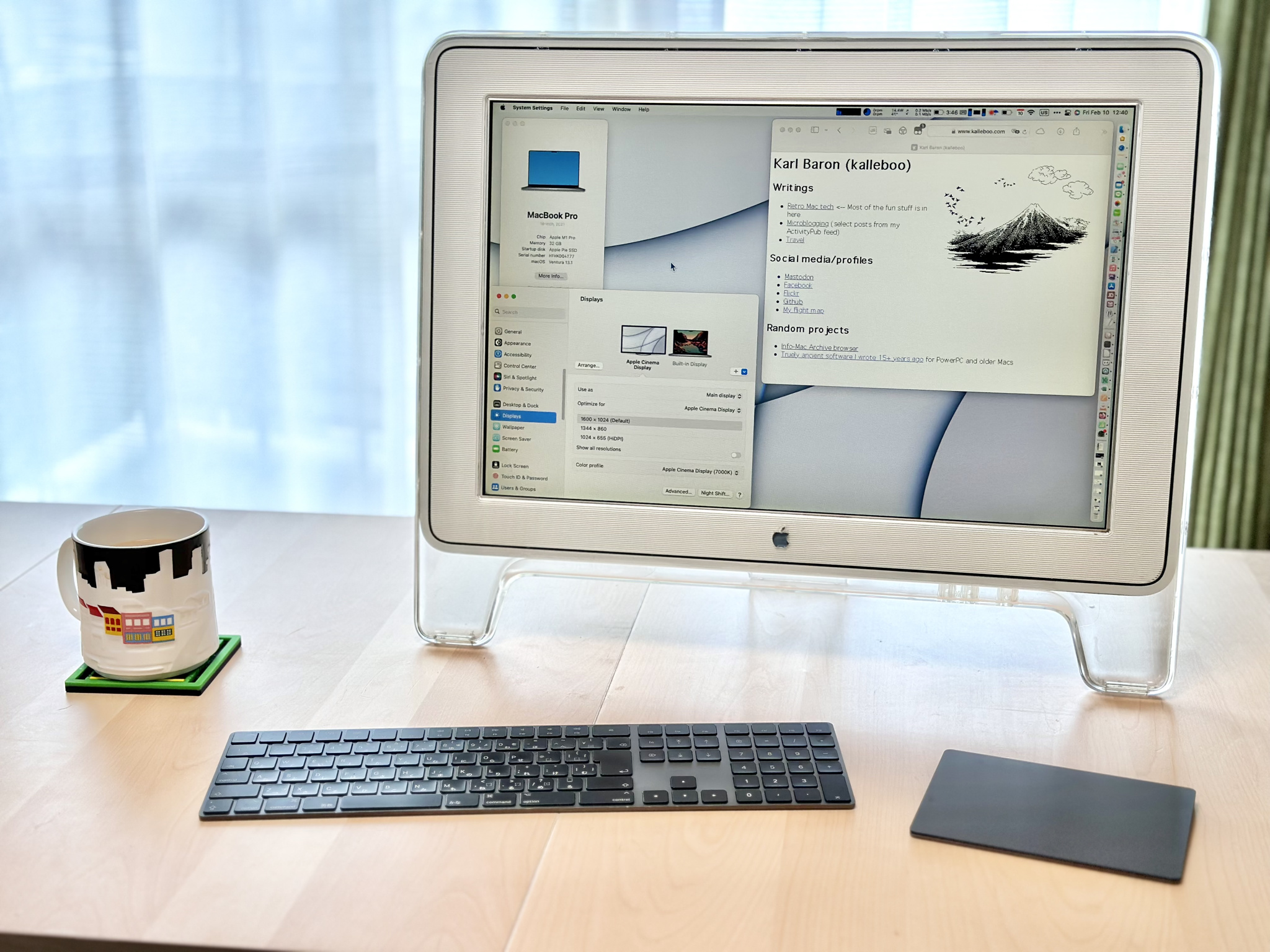
I was until quite recently. Bought a cheap 4k panel to replace it. I was really sick of the number of adapters to keep it going, plus it was never particularly bright and had low contrast.
Not using, but I still have it. I get it running every couple of years and it's striking how dim it is compared to modern monitors. Yet I just can't bring myself to dispose of it or the 2007 Mac Pro it's attached to, despite them having absolutely zero utility.


reply